If you only have a minute, here's what you need to know.
- Most organizations buying AI tools have never assessed whether their organization can absorb them. Cisco's study of 8,000 companies found only 13% are actually ready to deploy AI at scale. The other 87% are spending money on capability they can't operationalize.
- AI readiness isn't one thing. It's eight: Leadership Commitment, Strategic Alignment, Data Readiness, Technology Infrastructure, Talent & Skills, Process Maturity, Culture & Change Readiness, and Governance & Ethics. Weakness in any single dimension blocks the others.
- Two of those dimensions, Leadership and Strategic Alignment, function as multipliers. Organizations that score high on those two extract more value from every dollar invested in the other six.
- Industry benchmarks exist: financial services typically scores 2.8-3.5 out of 5.0, healthcare 2.0-2.8, manufacturing 2.2-3.0. Any dimension scoring below 3.0 acts as a blocker, no matter how strong the rest of the scorecard looks.
- This article gives you enough to sketch your own radar chart and find your weak spots. The rest of this series will show you what to do about each one.
I've written before about why AI pilots fail, and why only 10% of success comes from the technology itself. Most executives I talk to already know their AI initiatives are underperforming. What they don't know is where exactly their organization is breaking down and which problems to fix first.
That's a diagnosis problem. And almost nobody is doing it.
The purchase order that replaces strategy
Here's the pattern I see repeatedly. A leadership team reads the headlines, feels the competitive pressure, and makes a purchasing decision. Copilot licenses for 5,000 employees. An Azure OpenAI deployment. A handful of pilot projects with aggressive timelines.
Six months later, Copilot adoption is at 15%. The pilots produced impressive demos that nobody scaled. The Azure deployment is running one use case that could have been built with a Python script. The organization spent millions on AI capability and has almost nothing to show for it.
The problem isn't the tools. The problem is that nobody asked whether the organization was ready for them.
Cisco's 2025 AI Readiness Index surveyed 8,000 organizations globally. Only 13% qualified as "Pacesetters," companies actually converting AI investment into production value. Those Pacesetters were 4x more likely to move AI from pilot to production than everyone else. The gap wasn't technology budgets or model selection. It was organizational readiness across multiple dimensions simultaneously.
The organizations that succeed assessed their readiness before they started buying. The ones that struggle skipped diagnosis and went straight to procurement.
Eight dimensions, not one
AI readiness isn't a single score. It's a profile across eight distinct dimensions, and weakness in any one of them can block progress in all the others.
I've been refining this framework across multiple enterprise engagements. The eight dimensions that consistently determine whether an organization scales or stalls:
1. Leadership Commitment
This is the dimension most organizations overestimate. Having a CEO who talks about AI in earnings calls is not leadership commitment.
Leadership commitment means a named executive sponsor with dedicated time and authority over AI initiatives. Not "the CIO will oversee this alongside their other responsibilities." A person whose calendar reflects AI transformation as a primary obligation, not an afterthought. It means an AI steering committee with cross-functional representation, because AI that lives only in IT never reaches the business units where value is created. And it means a dedicated budget line item that isn't buried in general IT spend, because initiatives funded through discretionary budget get cut the first time the quarter looks tight.
Here's what a 2.0 looks like: the CEO mentioned AI at the last all-hands, someone in IT was told to "look into it," and there's no dedicated budget. A 4.0 looks different: a named sponsor reports to the board quarterly on AI progress, there's a cross-functional steering committee that meets biweekly, and AI has its own P&L line that survived two budget cycles.
Sustained sponsorship correlates with a 68% success rate. Without it, success drops to 11%. More than half of AI initiatives lose their executive sponsor within six months, usually because the sponsor treated it as a ribbon-cutting rather than a multi-year commitment. Article 2 goes deep on what the right sponsor looks like and why most companies get this wrong.
2. Strategic Alignment
Most AI roadmaps are technology wish lists. They catalog tools the organization wants to buy rather than business problems AI should solve.
Strategic alignment means linking every AI initiative to one of the company's top three to five business priorities. Not to vague goals like "explore AI" or "increase innovation." If your CEO's top priority is margin expansion in the North American retail division, your first AI initiative should trace a direct line to that outcome. If it doesn't, it won't survive the first budget review.
It also means having a use-case prioritization framework that weighs feasibility against impact against data readiness. Without one, organizations pursue whatever the loudest executive asks for or whatever the vendor demo looked most impressive. That's how you end up with 20 teams building 20 disconnected chatbots.
A 2.0 here looks like a list of 30 AI "opportunities" with no ranking criteria and no connection to business outcomes. A 4.0 looks like five prioritized use cases, each mapped to a business metric, with clear owners and quarterly checkpoints. The difference isn't sophistication. It's discipline. Article 3 covers why most AI roadmaps won't survive a budget review and how to build ones that will.
3. Data Readiness
This is where most AI projects actually die. Not in model selection, not in deployment, but in the data underneath. 85% of AI projects fail due to poor data quality or lack of relevant data.
Data readiness covers three things. First, quality: is the data accurate, complete, and current? Most organizations discover their data is far dirtier than they assumed once they try to feed it to a model. Second, accessibility: is the data centralized on a platform where AI services can reach it, or is it trapped in departmental silos, legacy databases, and someone's Excel spreadsheet? Third, governance: are permissions set correctly, is sensitive data classified, and do you know who can access what?
That third one is where Microsoft Copilot deployments have been a wake-up call. Multiple enterprises discovered that rolling out Copilot exposed over-permissioned SharePoint sites, giving employees AI-surfaced access to documents they were never supposed to see. The technology worked perfectly. The data governance underneath it didn't. Those organizations spent months on permission audits before the tool could be safely used.
Among top-performing organizations, 76% have fully centralized their data. Among everyone else, only 19%. That single gap explains more of the performance difference than any technology choice. Article 4 lays out the six-month workstream that fixes data readiness.
4. Technology Infrastructure
This is the dimension that gets the most attention and probably matters the least, at least in isolation.
Cloud capacity, a standardized AI/ML platform, an integration layer that connects AI services to existing systems, API management, compute scaling. These are necessary. They are nowhere near sufficient. The platforms are mature. Azure AI Foundry, Copilot Studio, Microsoft Fabric, AWS Bedrock, Google Vertex, and their equivalents provide more than enough technical foundation for any enterprise AI initiative shipping today.
Technology accounts for roughly 10% of what determines AI success. Yet it's where most organizations start and where most of the budget goes. This isn't an argument against investing in infrastructure. It's an argument against investing in infrastructure first, before you've addressed the seven dimensions that determine whether anyone uses what you build. Article 8 covers the platform layer that makes technology investments productive.
A 2.0 is running AI experiments on individual developers' laptops with no shared platform. A 4.0 is a standardized enterprise platform with self-service provisioning, monitoring, cost management, and integration connectors to your core systems. Most organizations are somewhere around 3.0 here already, which is fine. The bottleneck is almost never the platform.
5. Talent & Skills
A one-day workshop on prompt engineering changes nothing. I've watched organizations spend six figures on AI training programs that produce certificates and zero behavior change.
Talent and skills covers three layers. The first is AI literacy across the organization: does the average employee understand what AI can and can't do, and do they feel confident experimenting with it in their daily work? The second is practitioner depth: do you have dedicated AI/ML engineers, data scientists, and platform engineers who can build and maintain AI systems? The third is cross-functional fluency: can business analysts, product managers, and domain experts articulate problems in ways that translate to AI solutions?
Role-based training matters. An executive needs to understand AI's strategic implications and governance requirements. A middle manager needs to know how to redesign their team's workflows around AI capabilities. A software engineer needs hands-on experience with the tools and frameworks. A finance analyst needs practical training on AI-assisted analysis within their actual tools. One curriculum for all four audiences will fail all four.
Among top-performing organizations, 75% report AI proficiency across their staff. Among everyone else, 16%. That's the widest gap of any dimension in the data, and it's not a gap you close with a lunch-and-learn series. Article 6 breaks down why training programs fail and what works instead.
6. Process Maturity
AI can't optimize processes that aren't documented, standardized, or measured. This is the dimension that catches organizations off guard.
Here's a test. Pick any core business process in your organization, something like "how we approve a new vendor" or "how we onboard a new customer." Now ask three people in three different offices to describe the steps. If you get three different answers, your process maturity score is below 3.0, and AI will amplify the inconsistency rather than fix it.
The target state is making your implicit operating model explicit and machine-readable. That's where AI becomes transformative, when it can read your processes, identify bottlenecks, and suggest or execute improvements. But the starting point is much simpler: are your core business processes documented? Are they standardized across teams and geographies? Are they measured with KPIs that would tell you whether AI is actually improving them?
If the answer is no, AI deployment will produce anecdotes, not outcomes. You'll have impressive demos of AI "optimizing" a process that doesn't exist in any consistent form, and no way to measure whether the optimization made a difference. Article 5 covers the operating model that determines how processes and responsibilities are structured for AI.
7. Culture & Change Readiness
I've written about the AI adoption paradox in detail, including the finding that 31% of employees actively sabotage AI initiatives. Culture isn't a soft dimension. It's the one that determines whether your other seven investments get used or ignored.
Culture and change readiness encompasses three things. Psychological safety: do employees feel safe experimenting with AI, including producing bad outputs while learning? Change management: does the organization have a plan for how roles, workflows, and expectations will evolve, or is the implicit message "figure it out"? And tolerance for failure: when an AI pilot doesn't work, does the organization learn from it or kill the program?
The organizations that achieve the fastest adoption make it opt-in, not mandated. They create environments where early adopters become visible champions, where success stories spread organically, and where people adopt because they see peers getting better outcomes, not because they received a compliance email. Culture change through pull is more durable than culture change through push. But you have to know whether your culture can support that before you design the rollout.
A 2.0 looks like active resistance: employees avoiding AI tools, managers vocally skeptical in meetings, no change management plan. A 4.0 looks like organic experimentation: employees sharing tips in Slack channels, managers redesigning team workflows around AI, and a formal change management lead coordinating the transition.
8. Governance & Ethics
Most organizations frame this as a tradeoff: governance or speed. That's a false choice. The answer isn't less governance. It's governance designed for velocity.
This dimension covers four areas. Principles: has the organization documented what responsible AI use looks like, in specific terms, not a vague values statement? Policies: is there an acceptable use policy that employees actually know about, covering what data can go into AI tools, what outputs require human review, and what's off limits? Process: is there a review mechanism for new AI applications before they go into production, and can it turn around a decision in days rather than months? And identity: as AI agents start acting on behalf of the organization, who are they, what can they access, and who's accountable for what they do?
That last area is evolving fast. Microsoft's Entra Agent ID is one example of where this is heading: verified identity for every AI agent, not just every human user. Your governance framework needs to account for non-human actors that can read, write, and transact.
Here's the reality most leaders haven't fully absorbed: 68% of employees are already using AI tools without IT approval. Your people aren't waiting for your governance framework. They're working around it. The question isn't whether you need governance. It's whether your governance can move fast enough that people actually use the governed path instead of the shadow one. Article 7 shows how to build governance that protects without paralyzing.
The multiplier effect
Not all eight dimensions carry equal weight. Two of them, Leadership Commitment and Strategic Alignment, function as multipliers on everything else.
This makes intuitive sense. A brilliant data strategy accomplishes nothing if leadership isn't committed to funding it through the 6-12 months it takes to operationalize. A world-class AI platform collects dust if there's no strategic alignment on which problems to solve with it. Conversely, strong leadership and clear strategic direction amplify every other investment.
In the scoring model I use, Leadership and Strategic Alignment each carry 1.5x weight. The formula looks like this:
Scale: 1.0 to 5.0
This weighting means an organization scoring 4.0 on leadership and strategy but 3.0 on everything else will outperform an organization scoring 3.0 on leadership and strategy but 4.0 on everything else. The multipliers matter more than the averages.
Where industries typically score
Here's where industries tend to land based on the assessments I've seen and the broader research data:
Financial services: 2.8 to 3.5. Strongest in governance (3.5-4.5), reflecting decades of regulatory compliance muscle. Weakest in culture (2.0-3.0), where risk aversion that serves them well in banking works against them in AI experimentation.
Healthcare: 2.0 to 2.8. Strongest in governance (2.5-3.5), driven by HIPAA and clinical trial requirements. Weakest in data readiness (1.5-2.5), where fragmented EHR systems and interoperability challenges create a data infrastructure problem that predates AI by decades.
Manufacturing: 2.2 to 3.0. Strongest in process maturity (3.0-4.0), because manufacturing has been documenting and measuring processes since before software existed. Weakest in talent (1.5-2.5), where the AI skills gap intersects with an existing shortage of digital talent on factory floors.
Professional services: 2.3 to 3.2. Strongest in talent (3.0-4.0), because knowledge workers tend to adopt new tools faster. Weakest in technology infrastructure (2.0-3.0), where years of underinvestment in platforms create a foundation gap.
Company size matters too. Small companies ($50M-$200M revenue) typically score 1.8-2.5, constrained primarily by talent. Mid-market companies ($200M-$1B) score 2.3-3.2, with data readiness as the most variable dimension. Enterprise companies ($1B+) score 2.8-3.8 but struggle with organizational complexity and change fatigue.
These are ranges, not rules. But they give you a starting point for honest self-assessment.
The blocking rule
Here's the finding that makes executives most uncomfortable: any single dimension scoring below 3.0 blocks transformation, regardless of how strong the other dimensions look.
A financial services company with a 4.5 in governance and a 2.0 in culture will stall. Their compliance framework is excellent, but employees won't adopt the tools. A technology company with a 4.5 in talent and a 2.0 in data readiness will stall. Their engineers are eager and capable, but there's nothing clean to feed the models.
This is why holistic assessment matters. Organizations naturally invest in their strengths, the dimensions where they already score well, because progress feels easiest there. But the scorecard makes visible a different truth: the highest-ROI investment is always in your weakest dimension, because that's the one blocking everything else.
The pattern among top performers isn't one dominant strength. It's the absence of critical weaknesses. They score above threshold on every dimension simultaneously.
What to do this week
You don't need a consulting engagement to start. You need a whiteboard, 90 minutes, and the willingness to be honest.
Score each dimension. Pull together a cross-functional group, not just IT, and rate each of the eight dimensions on a 1-5 scale. Use the descriptions above as rough calibration. Where you find disagreement within the room, you've found a gap in organizational awareness, which is itself a finding.
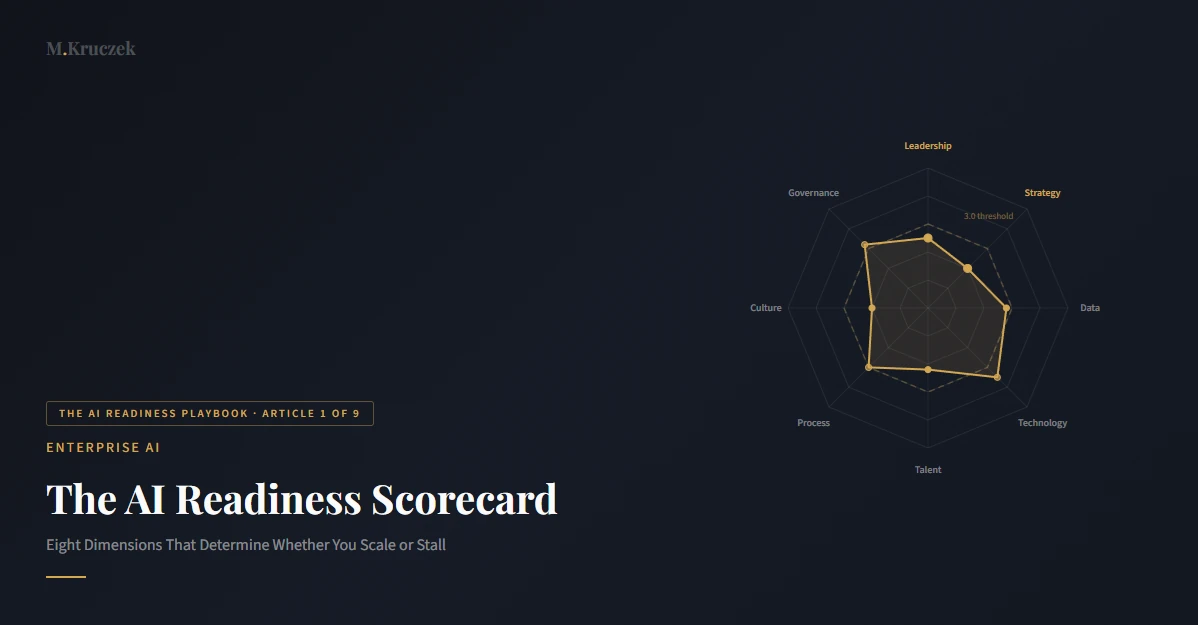
Plot the radar chart. Eight axes, one per dimension. The shape tells you more than the average. A spiky chart (high in some areas, low in others) indicates an organization investing unevenly. A uniformly low chart indicates an organization early in the journey. A chart with one or two deep dips below 3.0 shows you exactly what's blocking progress.
Find your blocker. Look for any dimension below 3.0. That's your first priority, not because it's the most exciting work, but because nothing else moves until it does. Leadership and Strategic Alignment below 3.0 are the most urgent because they're multipliers on everything else.
Stop buying tools for six weeks. This is the uncomfortable recommendation. If you haven't done this assessment, pause net-new AI tool purchases until you have. Every tool you buy before understanding your readiness profile is a bet that your organization can absorb it. The data says that's a bet you'll lose 87% of the time.
This is the first article in The AI Readiness Playbook series. The remaining articles walk through how to close the gaps this scorecard reveals: executive sponsorship, strategic alignment, data readiness, the operating model, AI literacy and skills, governance, engineering enablement, and the final piece on scaling from pilots to production.
The scorecard tells you where you are. The playbook tells you how to move.
References
- Cisco. "AI Readiness Index 2025." 8,000 organizations surveyed globally. cisco.com
- BCG. "From Potential to Profit: Closing the AI Impact Gap." January 2025. bcg.com
- BCG. "Enterprise as Code: Operating Model for the AI Era." December 2025. bcg.com
- Gartner. "AI Maturity Model and Roadmap Toolkit." gartner.com
- Microsoft. "Enterprise AI Maturity in Five Steps." October 2025. microsoft.com
- Kruczek, M. "The AI Adoption Paradox." matthewkruczek.ai. matthewkruczek.ai
This is Article 1 of 9 in "The AI Readiness Playbook" series, a step-by-step methodology for making your organization AI-ready. Connect with me on LinkedIn or Substack to discuss AI readiness assessment for your enterprise.