If you only have a minute, here's what you need to know.
- Most enterprise AI training programs fail because they treat AI literacy as a single skill. It is not. There are at least four distinct capability levels an organization needs, and training a finance VP the same way you train a data engineer produces expensive irrelevance for both.
- The four levels are: AI-aware (understands what AI can and cannot do), AI-literate (can evaluate AI outputs and identify appropriate use cases), AI-proficient (can configure, prompt, and integrate AI tools into workflows), and AI-native (can build, deploy, and govern AI systems). Every role in the organization maps to one of these levels. Most training programs only address the first two.
- The most common failure is the "lunch and learn" approach: a one-time awareness session, an executive briefing, maybe a vendor demo. This creates the illusion of progress without building durable capability. Six months later, nobody has changed how they work.
- The organizations that build real AI capability treat it like any other strategic skill development: role-specific curricula, hands-on practice with real workflows, measurable proficiency benchmarks, and accountability for adoption. They do not outsource this to HR or L&D alone. The AI program owns the skills strategy because the AI program knows what capabilities it actually needs.
- This article gives you the four-level framework for mapping roles to capability targets, the common failure modes that turn training investment into waste, and a 90-day skills sprint structure that produces measurable capability gains.
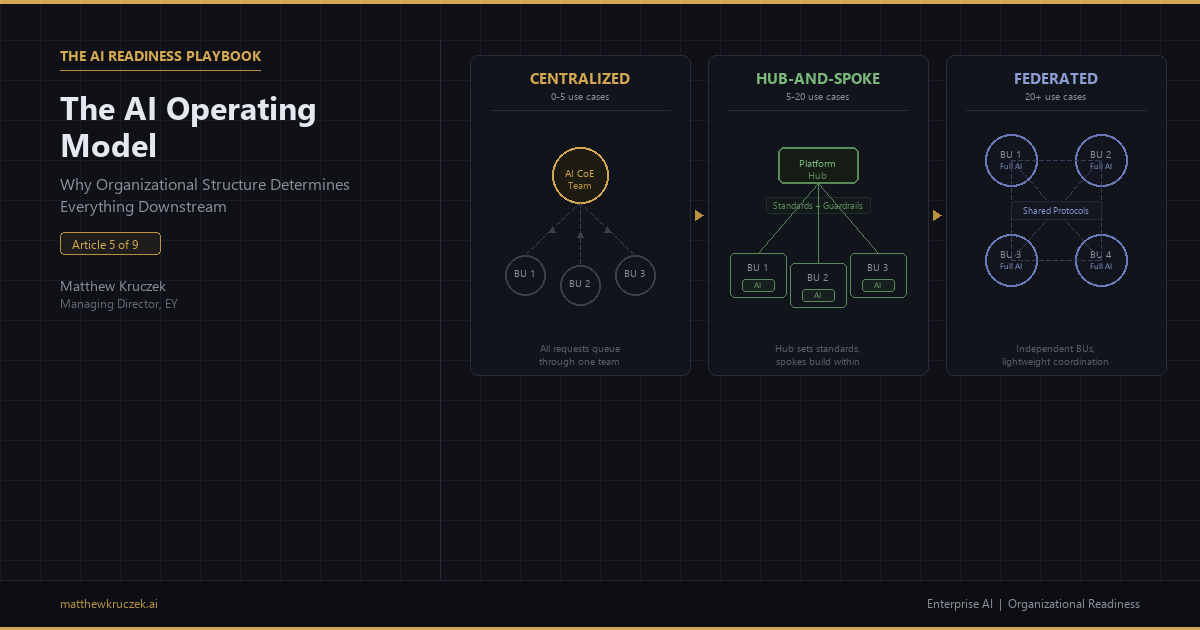
In the previous article, I laid out the three AI operating models and the structural decision that determines whether your organization can scale AI beyond pilot. But even the right operating model fails without the right people operating within it. A hub-and-spoke model with spokes that lack AI-proficient engineers is just a centralized model with extra org chart boxes.
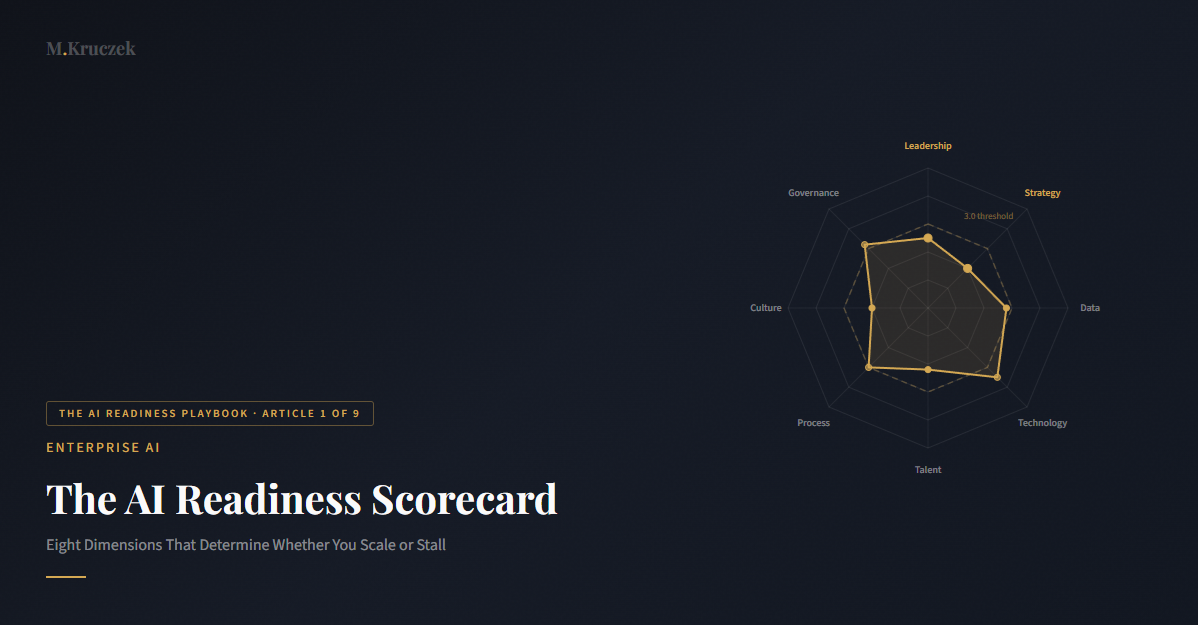
Talent and Skills is the fifth dimension on the AI Readiness Scorecard, and it is the dimension where organizations most consistently overestimate their position. Every enterprise I work with has "AI training" somewhere on their transformation roadmap. Almost none of them have a skills strategy that connects training investment to the specific capabilities their operating model requires.
The difference between having AI training and having an AI skills strategy is the difference between checking a box and building a capability. This article is about the latter.
The training program that changes nothing
Here is the pattern. Leadership approves an AI training budget. HR or L&D selects a vendor. The vendor delivers a series of sessions: "Introduction to AI," "AI for Business Leaders," "Prompt Engineering 101." Attendance is tracked. Completion certificates are issued. A slide in the next board deck reports that 2,000 employees have been "AI trained."
Six months later, nothing has changed. The finance team still runs the same manual reconciliation process. The marketing team still writes campaign briefs the same way. The operations team still manually triages support tickets. The training happened. The capability did not.
This failure has three root causes.
First, the training is generic. A one-size-fits-all AI curriculum treats a CFO, a product manager, a software engineer, and a customer service rep as if they need the same knowledge at the same depth. They do not. The CFO needs to evaluate AI investment decisions. The product manager needs to identify where AI fits in their product roadmap. The software engineer needs to build and integrate AI systems. The customer service rep needs to work effectively alongside AI-assisted tools. These are fundamentally different learning objectives, and a single curriculum cannot serve all of them.
Second, the training is theoretical. Slides about machine learning concepts and demos of ChatGPT do not build organizational capability. Capability comes from practice, specifically from applying AI tools to the actual work people do every day. An engineer who completes an "AI Fundamentals" course but never builds an AI-assisted feature in their real codebase has learned nothing durable. A sales leader who watches a demo of AI-powered forecasting but never uses it with their own pipeline data will revert to their existing process within weeks.
Third, the training has no accountability mechanism. Nobody measures whether the training actually changed how work gets done. Completion rates are not adoption rates. The organization tracks how many people sat through the sessions, not how many people changed their workflows as a result. Without measurement, there is no feedback loop, and without a feedback loop, there is no improvement.
Four levels of AI capability
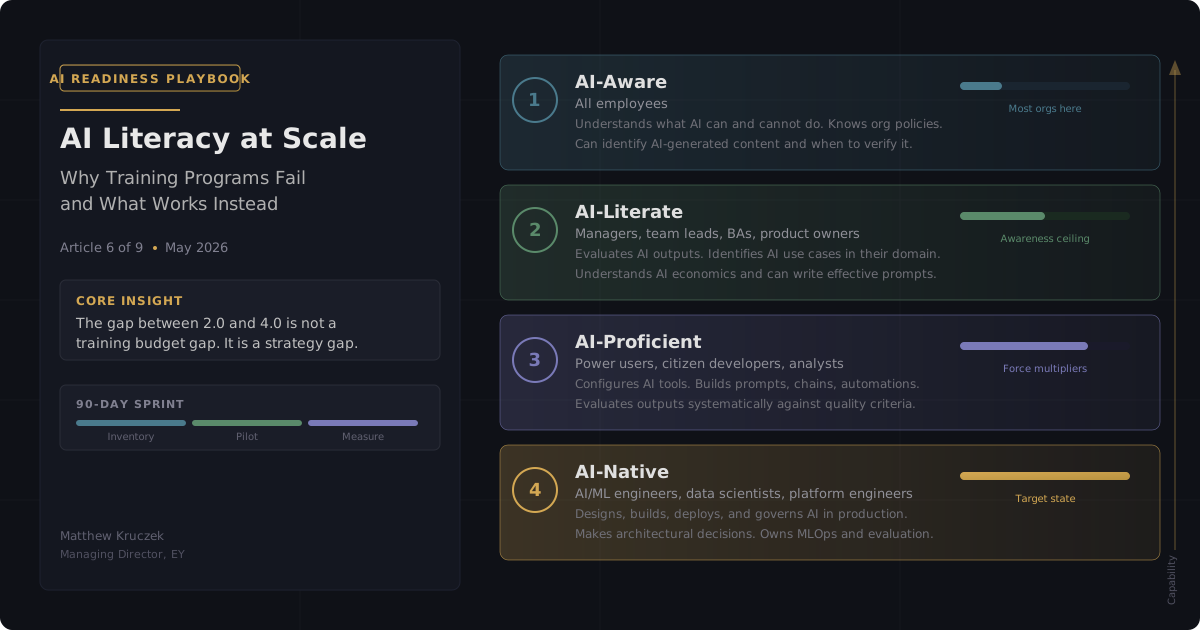
Not everyone in your organization needs to understand how transformer architectures work. But everyone needs to understand something about AI, and the "something" varies dramatically by role. The framework I use maps every role to one of four capability levels:
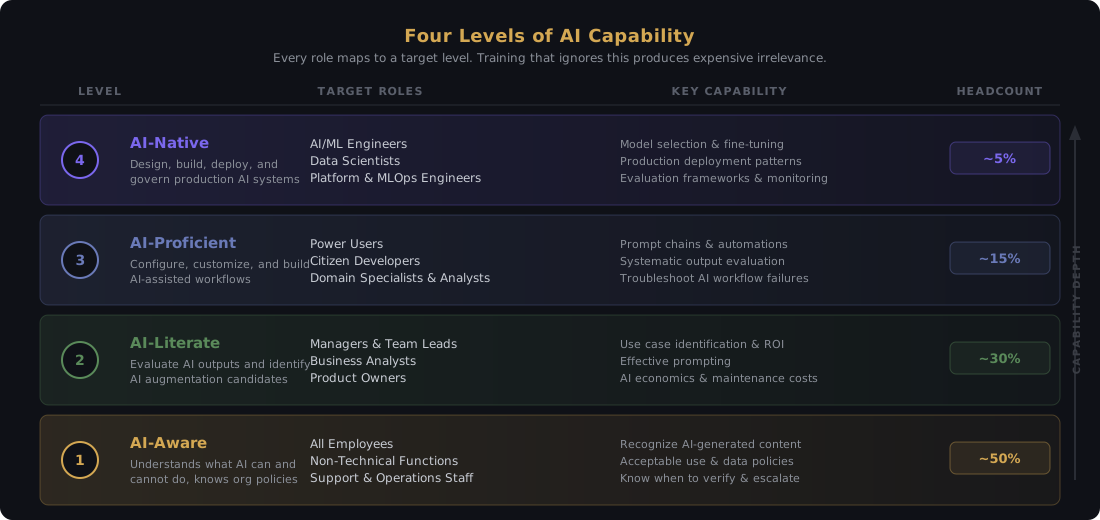
Figure 1: The four AI capability levels. Every role in the organization maps to one of these levels. Most training programs only address the first two.
Level 1: AI-Aware
Target roles: All employees, particularly those in non-technical functions.
What it means: Understands what AI is, what it can and cannot do reliably, and how the organization is using it. Can identify when they are interacting with an AI system. Understands the organization's AI policies, including acceptable use, data handling, and escalation procedures.
A 2.0 on AI-Aware looks like this: most employees have heard of AI but could not explain how it differs from traditional automation. They do not know which internal tools use AI. They have no framework for evaluating AI-generated output and default to either blind trust or blanket skepticism.
A 4.0 on AI-Aware looks like this: every employee has completed a role-appropriate AI orientation. They understand the organization's AI acceptable use policy. They can identify AI-generated content and know when to verify it. They know how to report AI outputs that seem wrong or biased. The orientation is refreshed annually as capabilities and policies evolve.
Level 2: AI-Literate
Target roles: Managers, team leads, business analysts, product owners, and any role that evaluates or commissions work.
What it means: Can evaluate AI outputs for accuracy and fitness for purpose. Can identify processes in their domain that are candidates for AI augmentation. Understands the basic economics of AI (what it costs, where the ROI comes from, what the ongoing maintenance requirements are). Can write effective prompts and evaluate whether an AI tool is performing adequately.
A 2.0 on AI-Literate looks like this: managers know AI exists and have opinions about it, but those opinions are shaped by vendor demos and media coverage rather than hands-on experience. They cannot distinguish between a process that is a good AI candidate and one that is not. They approve AI initiatives based on enthusiasm rather than structured evaluation.
A 4.0 on AI-Literate looks like this: managers and team leads can independently identify three to five processes in their domain suitable for AI augmentation, articulate the data requirements, estimate the business impact, and evaluate whether the output quality meets the bar. They use AI tools daily in their own work and can coach their teams on effective use. They participate in use case intake and prioritization with informed judgment, not just aspiration.
Level 3: AI-Proficient
Target roles: Power users, domain specialists who configure AI tools, citizen developers, analysts who build AI-assisted workflows.
What it means: Can configure and customize AI tools for specific business workflows. Can build prompts, chains, and lightweight automations. Can evaluate model outputs systematically (not just "does this look right?" but against defined quality criteria). Can troubleshoot when AI-assisted workflows produce unexpected results.
A 2.0 on AI-Proficient looks like this: a few enthusiastic individuals have taught themselves to use AI tools, but their knowledge is ad hoc and not transferable. They build solutions that work for them personally but cannot be maintained by anyone else. There is no shared methodology for building AI-assisted workflows, so every team reinvents the wheel.
A 4.0 on AI-Proficient looks like this: each business unit has identified its power users and invested in structured proficiency training tied to their actual workflows. These users can build, test, and document AI-assisted workflows that others can adopt. A shared playbook of patterns and templates accelerates new development. Proficient users serve as first-line support for their teams and as the bridge between business needs and the AI engineering team.
Level 4: AI-Native
Target roles: AI/ML engineers, data scientists, platform engineers, MLOps specialists.
What it means: Can design, build, deploy, evaluate, and maintain AI systems in production. Understands model selection, training, fine-tuning, evaluation frameworks, deployment patterns, monitoring, and governance. Can make architectural decisions about when to use AI and when not to.
A 2.0 on AI-Native looks like this: the organization has hired a small team of data scientists, but they operate in isolation from the engineering organization. They can build models in notebooks but struggle to deploy them in production. MLOps is manual. Evaluation is informal. The team is overloaded because they are the only people in the organization who can do any AI work at all.
A 4.0 on AI-Native looks like this: AI engineering is a recognized discipline within the engineering organization, with its own career ladder, hiring criteria, and professional development path. Engineers have deep expertise in production AI systems, not just model training. MLOps, evaluation frameworks, and monitoring are mature. The team operates within the operating model (hub or spoke) with clear accountability and interfaces.
The capability gap that kills operating models
The four levels map directly to the operating model decisions from Article 5. A centralized model can function with Level 4 talent concentrated in one team, as long as the rest of the organization is at least Level 1. But a hub-and-spoke model requires Level 4 talent in both the hub and the spokes, Level 3 talent distributed across business units, and Level 2 capability in every management layer.
This is where most organizations discover the real bottleneck. They design a hub-and-spoke operating model on paper, then realize they do not have enough Level 3 and Level 4 talent to staff the spokes. The spokes become dependent on the hub for everything, which means the organization is running a centralized model with extra overhead.
The skills strategy must be designed in lockstep with the operating model. If you are planning to transition from centralized to hub-and-spoke in 12 months, you need Level 3 and Level 4 talent development starting now, not after the restructuring.
Common failure modes
The vendor-led curriculum. The organization outsources its entire AI training strategy to a platform vendor or consulting firm. The vendor delivers generic content optimized for broad applicability, not for the organization's specific operating model, tech stack, or use case portfolio. The training is polished but disconnected from reality. Employees complete it, check the box, and never apply it.
The hero-dependent model. One or two self-taught AI enthusiasts become the de facto AI capability for their entire department. Leadership treats this as "we have AI skills in that team" without recognizing that the capability lives in individuals, not in the organization. When those individuals leave or burn out, the capability vanishes overnight.
The awareness ceiling. The organization invests heavily in Level 1 (AI-Aware) training because it is the easiest to deliver at scale. Everyone attends the sessions. Leadership reports high participation. But nobody invests in Level 2, 3, or 4 because those require role-specific curricula, hands-on labs, and ongoing coaching, which are harder and more expensive. The organization becomes broadly aware of AI but incapable of doing anything with it.
The skills-strategy disconnect. The AI program and the L&D function operate independently. The AI program knows what capabilities it needs but has no mechanism to develop them. L&D has the training infrastructure but does not know what the AI program actually requires. The result is training that does not match demand and demand that training does not satisfy.
Measuring inputs, not outcomes. The organization tracks training hours, course completions, and certifications. It does not track whether trained employees actually changed their workflows, built AI-assisted processes, or contributed to AI initiatives. The metrics show activity. They do not show capability.
The 90-day skills sprint
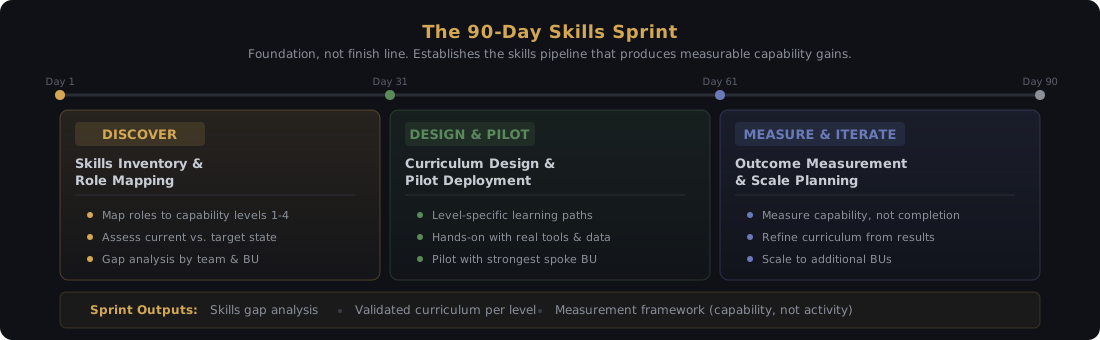
Figure 2: The 90-day skills sprint. Three phases that produce a skills gap analysis, validated curriculum, and measurement framework.
A 90-day sprint will not solve your entire AI skills gap, but it will establish the foundation: a clear picture of where capability stands today, role-level targets, and a working training pipeline that produces measurable results.
Days 1 to 30: Skills inventory and role mapping. Map every role in the organization to one of the four capability levels. This is not a theoretical exercise. For each role, ask: what does this person need to be able to do with AI in 12 months? The answer determines the target level. Then assess current state: where are people today versus where they need to be? The gap analysis, aggregated by team and business unit, is your demand signal.
Days 31 to 60: Curriculum design and pilot. For each capability level, design a learning path that combines structured content with hands-on practice using the organization's actual tools and data. Level 1 can be delivered as self-paced content. Levels 2 and 3 require facilitated workshops with real workflow exercises. Level 4 requires project-based learning and mentorship. Pilot with one business unit: the strongest spoke candidate from your operating model work.
Days 61 to 90: Measure and iterate. After the pilot, measure outcomes, not completions. For Level 2 participants: can they now identify viable AI use cases in their domain? For Level 3 participants: have they built at least one AI-assisted workflow that others can use? For Level 4 participants: have they shipped or materially contributed to a production AI system? Use the results to refine the curriculum before scaling to additional business units.
The 90-day sprint produces three outputs: a skills gap analysis that quantifies the development investment required, a validated curriculum for each capability level, and a measurement framework that tracks capability, not just activity.
Scoring 2.0 versus 4.0
A 2.0 organization has invested in AI awareness but not AI capability. Most employees have heard of AI. A few teams have self-taught enthusiasts. There is no formal skills strategy, no role-level capability targets, and no measurement of whether training translates to changed behavior. The AI team is understaffed and overloaded because they are the only people who can do AI work. Business units cannot participate meaningfully in AI initiatives because they lack the skills to contribute.
A 4.0 organization has a deliberate skills strategy aligned to its operating model. Every role has a defined capability target. Training is role-specific, hands-on, and measured by outcomes. Level 3 power users exist in every business unit and serve as force multipliers. Level 4 talent is sufficient to staff the operating model (hub and spokes, if applicable). Leadership tracks AI capability as a strategic metric alongside revenue, margin, and customer satisfaction.
The gap between 2.0 and 4.0 is not a training budget gap. It is a strategy gap: the difference between training people and building capability.
What to do this week
Map your roles to capability levels. Take your top 20 roles by headcount and assign each a target AI capability level (1 through 4). If every role maps to Level 1, you are underestimating what your operating model requires. If more than three roles map to Level 4, you may be overestimating what is achievable in the near term. The mapping should feel uncomfortable: it forces specificity about what "AI-enabled workforce" actually means.
Audit your current training. List every AI-related training initiative currently running or planned. For each, identify which capability level it addresses and whether it includes hands-on practice with real workflows. If everything targets Level 1 or is entirely theoretical, your training portfolio has a structural gap that no amount of additional sessions will close.
Identify your Level 3 candidates. In every business unit, there are people who have already taught themselves to use AI tools effectively. Find them. They are your best candidates for structured Level 3 development, and once trained, they become the force multipliers who accelerate adoption across their teams. Do not make the mistake of treating them as anomalies. They are your leading indicators.
Connect skills to your operating model. If you designed a hub-and-spoke model in Article 5, check whether your spoke BUs have enough Level 3 and Level 4 talent to operate independently. If they do not, your skills sprint timeline determines your operating model transition timeline, not the other way around.
The scorecard in Article 1 measures Talent and Skills as a standalone dimension, but this article shows how deeply it connects to the operating model from Article 5. You cannot staff a model you have not built capability for. The next article in the series turns to Governance: how to build AI oversight that operates at the speed of innovation rather than the speed of committee.
Matthew Kruczek is Managing Director at EY, leading Microsoft domain initiatives within Digital Engineering. Connect with Matthew on LinkedIn to discuss AI skills strategy and workforce readiness for your enterprise.
References
- McKinsey. "The State of AI in 2025." Organizations with formal AI skills programs are 3x more likely to capture value from AI investments. mckinsey.com
- Kruczek, M. "The AI Readiness Scorecard." Talent and Skills as a core dimension of AI organizational readiness. matthewkruczek.ai
- World Economic Forum. "Future of Jobs Report 2025." AI literacy as a top-five skill requirement across industries by 2027. weforum.org
- Harvard Business Review. "Reskilling in the Age of AI." Why traditional L&D models fail to build AI capability and what replaces them. hbr.org
- Kruczek, M. "The AI Operating Model." The structural decision that determines what talent the organization needs. matthewkruczek.ai
- McKinsey. "Superagency in the Workplace: Empowering People to Unlock AI's Full Potential at Work." 46% of C-suite leaders cite talent and skill gaps as the leading barrier slowing AI adoption. mckinsey.com
This is Article 6 of 9 in "The AI Readiness Playbook" series, a step-by-step methodology for making your organization AI-ready.