If you only have a minute, here's what you need to know.
- Enterprise AI governance exists in two states: absent or suffocating. Organizations either have no governance framework, or they have a committee-based process that adds six to twelve weeks to every initiative. Both fail. The first creates unmanaged risk. The second kills innovation by making governance slower than the development cycle it governs.
- The organizations getting this right treat governance as infrastructure, not bureaucracy. Tiered risk classifications route low-risk work through automated guardrails and reserve human review for genuinely novel or high-risk applications.
- Three governance models exist: committee (approval-based, reactive, slow), guardrail (automated policies, pre-certified patterns, fast), and embedded (integrated into the operating model, continuous). Most enterprises need to move from the first to the second.
- The most common failure is governance theater: a process that exists on paper, approves everything, and provides no actual risk mitigation.
- This article gives you a three-tier risk classification, the governance operating model that matches your maturity, and a 90-day sprint for building governance that protects without paralyzing.
78% of organizations now use AI in at least one business function. Only 9% describe their governance as mature.
Source: McKinsey, State of AI 2025
That gap, between adoption and oversight, is where the next wave of enterprise AI failures will originate. Not from bad models or insufficient data, but from organizations that scaled AI faster than they scaled the structures governing it.
In the previous article, I laid out the four levels of AI capability and the skills strategy that makes your operating model work. But even an organization with the right structure and the right talent will stall if every AI initiative must navigate a governance process designed for a different era.
Governance is the sixth dimension on the AI Readiness Scorecard, and it is the dimension where organizations most often confuse activity with effectiveness. Having a governance committee is not the same as having governance. Having a responsible AI policy on the intranet is not the same as having guardrails that prevent irresponsible AI from reaching production.
The question is not whether your organization has AI governance. The question is whether your governance operates at the speed of your AI program or at the speed of committee.
The two failure states
Here is the pattern I see in organizations two to three years into their AI journey. The AI team has built momentum. Use cases are moving from pilot to production. The operating model from Article 5 is starting to take shape. Then governance becomes the bottleneck.
Failure state 1: No governance at all. Common in organizations that moved fast early, building POCs and pilots without creating oversight structures. Only 25 percent of organizations have fully implemented AI governance programs. At small scale, informal judgment calls work. A trusted team of five engineers making risk decisions is not the same as 50 people across eight business units making those calls independently. At scale, "we trust the team" is not a governance framework. It is an assumption that stops being valid around the time your third business unit starts deploying AI to customers.
42% of companies abandoned most AI initiatives in 2025, up from 17% the year before.
Source: S&P Global
Many did not fail because of bad technology. They failed because they could not answer basic governance questions when leadership, regulators, or customers asked.
Failure state 2: Committee governance. This emerges when leadership realizes the first state is untenable. The response is predictable: form a committee. The AI Governance Board meets monthly (sometimes quarterly). Every AI initiative above some loosely defined threshold must be reviewed. The committee includes representatives from legal, compliance, security, privacy, the AI team, and two business stakeholders who attend intermittently.
56% of enterprises take 6-18 months to move a GenAI project from intake to production. 44% of AI leaders describe their governance process as "too slow."
Source: ModelOp, 2025 AI Governance Benchmark
By the time the committee reviews a use case, the business context has changed, the model has been updated twice, and the team that submitted the request has moved on to other work. The committee approves almost everything because rejecting an initiative that a VP has already funded creates more organizational friction than the committee can absorb.
This is governance theater. It looks like oversight. It provides no actual risk mitigation. And it adds months to every initiative's timeline. Nearly half of organizations have encountered measurable governance or ethical lapses linked to their generative AI projects. The committee did not prevent those lapses. It just made everything slower.
What governance actually needs to do
Before designing a framework, clarify what governance must accomplish. AI governance serves four functions:
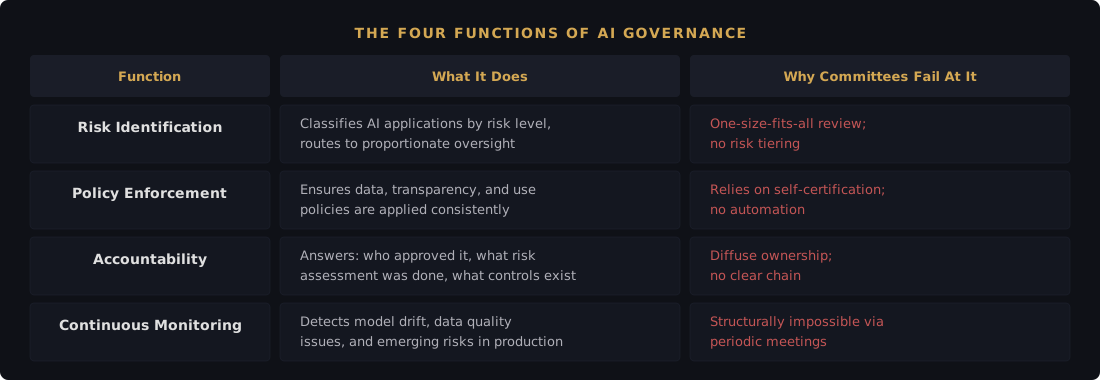
Figure 1: The four functions of AI governance. Committee governance attempts all four through periodic review meetings, failing at each.
The problem with committee governance is that it attempts all four functions through a single mechanism: a periodic review meeting. That mechanism is too slow for risk identification, too infrequent for policy enforcement, too diffuse for accountability, and structurally incapable of continuous monitoring.
There is a counterargument worth addressing directly: governance done well actually accelerates AI delivery. One major financial services firm cut its AI time-to-market in half and reduced issue resolution time by 80 percent after implementing lifecycle governance automation. When teams know what is pre-approved and what requires review, they stop guessing, stop waiting for informal approvals, and stop building things that will get blocked later. Clear governance eliminates the rework cycle that ungoverned AI creates.
The goal is not governance versus speed. It is governance that produces speed.
The regulatory context you cannot ignore
This article is about operational governance, not regulatory compliance. But the regulatory landscape shapes the floor your governance framework must stand on.
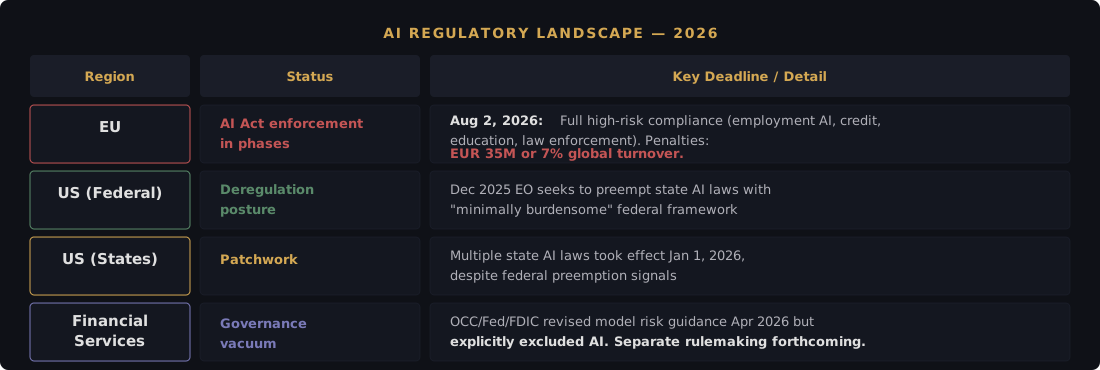
Figure 2: The regulatory landscape in 2026. Build to the higher standard.
The practical implication: build to the higher standard. Organizations that design governance around the EU AI Act will satisfy US requirements automatically. Organizations that design around the current US posture will face expensive retrofits when regulation tightens.
If your AI program operates in financial services, you are building in a governance vacuum that will be filled by regulators. What they fill it with will not be shaped by your preferences unless you have a defensible framework already in place.
Three governance models
Like the operating models from Article 5, governance models exist on a maturity curve. Each works at a specific stage. None works at all stages.
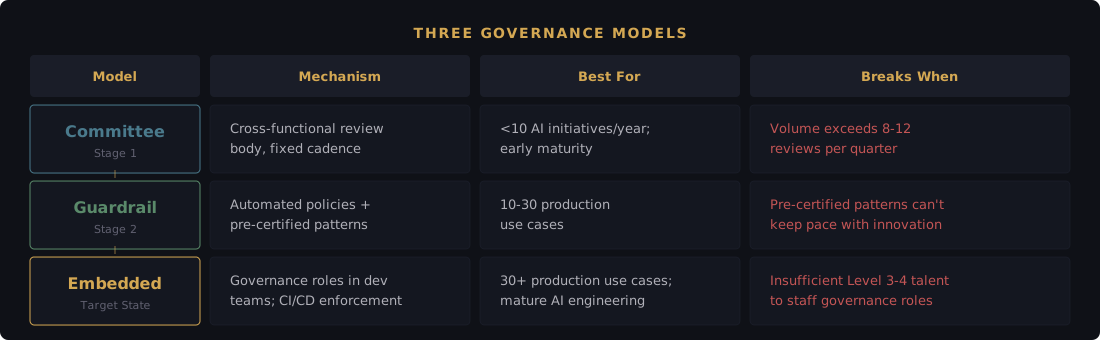
Figure 3: Three governance models. Each works at a specific maturity stage. None works at all stages.
Committee governance
The committee model centralizes all AI oversight in a cross-functional review body. Every initiative is reviewed before deployment on a fixed cadence.
A 2.0 looks like this: the committee exists but meets irregularly. No risk tiering, so a low-risk internal tool gets the same review as a high-risk autonomous agent. The committee is advisory only. Teams that want to avoid the process simply do not submit their work for review.
A 4.0 looks like this: standing cadence, clear criteria, and real authority. A defined risk classification determines what requires review. The committee tracks its own throughput and cycle times. But even a well-run committee tops out at 8 to 12 reviews per quarter. If your AI program produces more than that, the model cannot scale.
Guardrail governance
The guardrail model replaces approval gates with automated policies and pre-certified patterns. Instead of reviewing every initiative, the organization defines categories of AI work that are pre-approved when they stay within specified boundaries.
Think of it as the building code analogy from the operating model article. The governance team writes the code. Teams build within the code. Only work that falls outside pre-certified patterns requires human review.
A 2.0 looks like this: written policies but no automated enforcement. Teams self-certify compliance. Self-certification is inconsistent. Nobody audits whether teams follow the policies they claim to follow.
A 4.0 looks like this: automated checks validate data handling, transparency, and acceptable use before deployment. Pre-certified patterns cover common use cases (summarization, classification, RAG within approved data sources). A standing sprint (not quarterly committee) handles exceptions. The governance team measures two things: coverage rate and exception rate.
Embedded governance
The embedded model integrates governance into the AI development lifecycle. Governance is not something that happens to AI projects. It is something that happens within them.
A 2.0 looks like this: "governance is everyone's responsibility" but nobody has specific accountability. Risk assessments are done retroactively, if at all.
A 4.0 looks like this: every AI team includes a governance role. Risk classification happens at inception and updates as scope changes. Automated guardrails are in CI/CD pipelines. Model monitoring and drift detection trigger reviews proactively. The governance function measures mean time to approve and mean time to detect.
Embedded governance is the target state for organizations with 30+ production use cases. It requires Level 3 and Level 4 talent (from Article 6) who understand both the technical and governance dimensions.
The three-tier risk classification
The foundation of any scalable governance model is risk tiering. Not all AI applications need the same oversight. A risk classification creates proportionate governance.
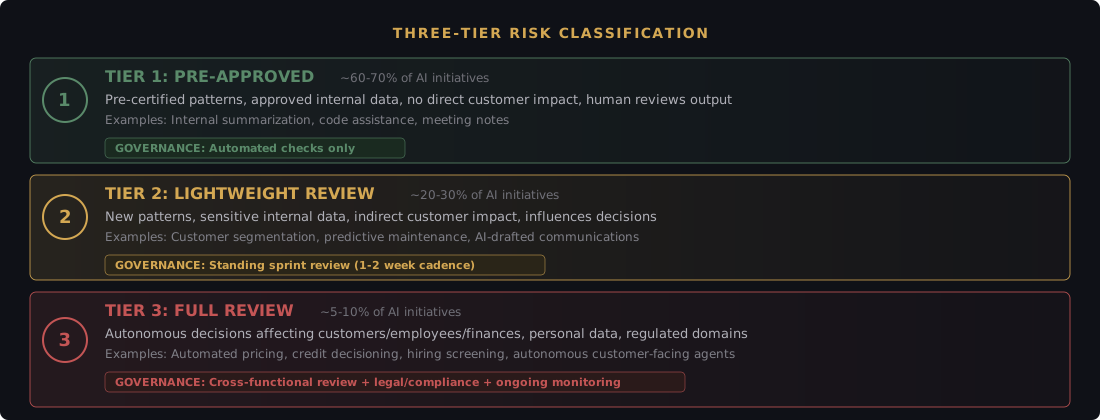
Figure 4: Three-tier risk classification. 60-70% of initiatives in a mature program should fall into Tier 1.
60-70% of AI initiatives in a mature program should fall into Tier 1. These are the internal tools, the productivity enhancements, the workflow automations that make up the bulk of the portfolio. If every one requires a committee review, governance becomes a bottleneck. If none requires any oversight, governance becomes fiction.
Common failure modes
Governance theater. The committee meets. Approvals are granted. Nothing is evaluated against defined criteria. Diagnose this by asking: when was the last time the governance body rejected or materially changed an AI initiative? If the answer is "never," the process is not governing anything.
The one-size-fits-all review. Every initiative gets the same process regardless of risk. An internal FAQ chatbot gets the same scrutiny as an autonomous trading agent. This wastes capacity on low-risk work and creates backlogs that delay high-risk reviews.
Governance without teeth. Advisory only. Teams that disagree deploy anyway. Violations have no consequences. This is worse than no governance because it creates the illusion of oversight while providing none.
The compliance-only approach. Legal and compliance own governance entirely. Focus on regulatory requirements to the exclusion of operational risks (model drift, hallucination rates, failure modes). Legally compliant but operationally ungoverned.
Calendar-driven oversight. Reviews happen on a fixed schedule regardless of deployment timing. A high-risk application that deploys on October 3 does not get reviewed until the November meeting. Five weeks in production with no oversight.
Scoring 2.0 versus 4.0
A 2.0 organization has governance in name only. There may be a committee, a policy document, or a responsible AI statement, but none connects to actual deployment and operation. No risk classification. Governance on a quarterly cadence while development runs weekly. No automated guardrails. Nobody can answer: "How many AI systems are in production, and what risk level is each?"
A 4.0 organization has a governance framework that scales. Risk classification routes initiatives to proportionate oversight. Automated guardrails cover the majority of low-risk deployments. Standing cadence handles exceptions within one to two weeks. Continuous monitoring detects issues proactively. Leadership can see a real-time view of the AI portfolio, risk exposure, and governance compliance.
The gap between 2.0 and 4.0 is not a policy gap. It is an infrastructure gap: the difference between governance as a document and governance as a system.
The agentic AI governance problem
Everything above applies to conventional AI. Agentic AI, where systems take autonomous action across multiple tools and systems, introduces challenges most frameworks are not designed to handle.
23% of enterprises already use agentic AI at least moderately. Within two years, 74% expect moderate use. But only 1 in 5 has a mature governance model for autonomous agents.
Source: Deloitte, State of AI in the Enterprise 2026
The governance gap is structural. Agentic AI does not fit the "review the model before deployment" pattern because behavior depends on the tools it can access, the data it can reach, and the autonomy it has been granted, all of which can change without redeploying the model. A customer service agent that can only look up order status is a different risk profile from the same model with refund processing access, even if the underlying model is identical.
Your risk classification must assess not just the model but the agent's scope of action: what systems it can access, what decisions it can make autonomously, and what escalation paths exist. This is a harder problem than governing static models, and most organizations have not started solving it.
The 90-day governance sprint
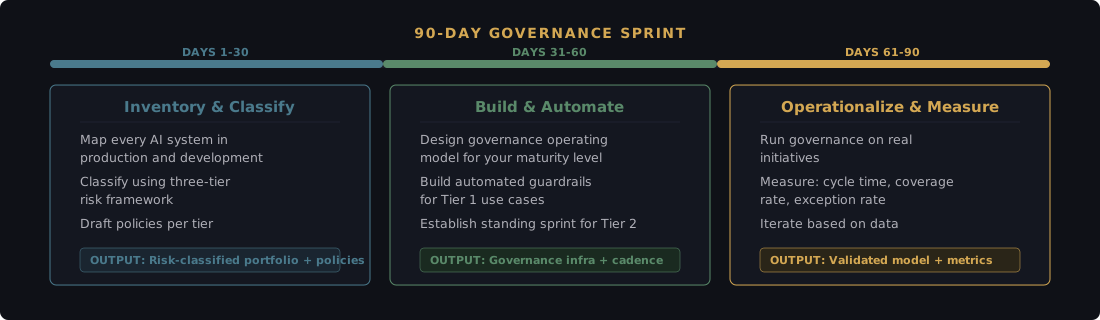
Figure 5: The 90-day governance sprint. Three phases from inventory through automation to operationalization.
Key metrics to track:
- Cycle time: How long from submission to decision (Tier 2 and Tier 3). Target: <2 weeks for Tier 2.
- Coverage rate: What percentage of deployments pass through automated guardrails. Target: >70%.
- Exception rate: How often work falls outside pre-certified patterns. If >40%, patterns are too narrow.
What to do this week
Inventory your AI systems. List every AI application in production, development, or planning across the organization. If you cannot produce this list quickly, that itself is a governance finding. You cannot govern what you cannot see.
Classify by risk tier. Assign each to Tier 1, Tier 2, or Tier 3. If more than 30 percent land in Tier 3, your criteria may be too conservative. If fewer than 10 percent land in Tier 3, you may be underestimating risk.
Measure your current cycle time. How long from "initiative proposed" to "approved for deployment"? If you do not know, that is a governance gap. If the answer is more than four weeks for Tier 1 work, governance is the bottleneck, not the safeguard.
Ask the "last rejection" question. When did your governance body last reject, materially alter, or delay an initiative based on risk concerns? If the answer is never, governance is not governing. If the answer is "every initiative gets delayed," governance is not enabling. Neither answer is acceptable.
The scorecard in Article 1 measures Governance as a standalone dimension, but this article shows how it connects to the operating model from Article 5 and the skills strategy from Article 6. The operating model determines who builds. The skills strategy determines whether they can build well. Governance determines whether what they build is safe, compliant, and aligned with organizational risk tolerance.
The next article addresses the engineering enablement that makes all of this operational: the platform, tooling, and infrastructure that turns governance policies into automated guardrails.
Matthew Kruczek is Managing Director at EY, leading Microsoft domain initiatives within Digital Engineering. Connect with Matthew on LinkedIn to discuss AI governance frameworks and scaling responsible AI for your enterprise.
References
- McKinsey. "The State of AI: How Organizations Are Rewiring to Capture Value." 78% AI adoption, 9% governance maturity, nearly half report measurable governance lapses. mckinsey.com
- ModelOp. "2025 AI Governance Benchmark Report." 56% report 6-18 month intake-to-production cycles; 44% describe governance as "too slow." modelop.com
- Deloitte. "State of AI in the Enterprise, 2026." Only 1 in 5 organizations has mature governance for agentic AI; 73% cite data privacy as top AI risk. deloitte.com
- S&P Global. "AI Initiative Abandonment Survey." 42% of companies abandoned most AI initiatives in 2025, up from 17% the prior year.
- NIST. "AI Risk Management Framework (AI RMF 1.0)." The foundational framework for identifying, assessing, and mitigating AI risk. nist.gov
- Gartner. "Top Predictions for Data and Analytics 2026." By 2030, 50% of AI agent deployment failures will trace to insufficient governance enforcement. gartner.com
- OCC. "Revised Model Risk Management Guidance (Bulletin 2026-13)." Explicitly excludes AI from scope; separate AI-specific rulemaking forthcoming. occ.treas.gov
- EU AI Act. "Implementation Timeline." Full high-risk compliance deadline August 2, 2026. artificialintelligenceact.eu
- ISO. "ISO/IEC 42001:2023." The international standard for AI management systems. iso.org
- Kruczek, M. "The AI Readiness Scorecard." Governance as a core dimension of AI organizational readiness. matthewkruczek.ai
- Kruczek, M. "The AI Operating Model." The structural decision that determines how governance is distributed. matthewkruczek.ai
- Kruczek, M. "AI Literacy at Scale." The skills strategy that determines whether teams can execute within governance guardrails. matthewkruczek.ai
This is Article 7 of 9 in "The AI Readiness Playbook" series, a step-by-step methodology for making your organization AI-ready.