If you only have a minute, here's what you need to know.
- More than half of AI initiatives lose their executive sponsor within six months. Sustained sponsorship correlates with a 68% success rate. Without it, success drops to 11%. This isn't a soft correlation, it's the single largest predictor of whether your AI investment pays off.
- The most common failure isn't the absence of a sponsor. It's the presence of the wrong kind. The ribbon-cutting sponsor who approved the budget and moved on. The delegating sponsor who assigned it to a direct report. The cheerleader sponsor who talks about AI in every meeting but never makes a trade-off decision.
- The right sponsor has three things: budget authority that survives quarterly pressure, cross-functional clout that reaches beyond IT, and calendar time that proves this is a primary obligation rather than a side project. Title matters less than these three conditions.
- 26% of organizations now have a Chief AI Officer, up from 11% two years ago. But adding a title doesn't solve the problem. The question isn't whether you need a CAIO. It's whether anyone has clear, singular accountability for AI strategy, guardrails, and value realization.
- This article gives you five anti-patterns to audit against and a 30-day test to determine whether your current sponsor is working.
In the previous article, I introduced an eight-dimension scorecard for AI readiness and argued that Leadership Commitment functions as a 1.5x multiplier on every other dimension. Strong leadership amplifies every dollar you invest in data, talent, and technology. Weak leadership wastes it.
But I left a question open: what does strong AI leadership actually look like in practice? Because the problem I see most often isn't that organizations lack a sponsor. It's that they have the wrong one.
The ownership vacuum
A Harvard Business Review piece from March 2026 describes a scene I've witnessed in some variation at least a dozen times. The CEO of a major global insurer convened his senior team and asked who should own AI. Every C-suite member raised their hand. The CIO claimed it as a systems and infrastructure challenge. The COO argued that agentic AI meant workforce transformation, making it operational. The CFO pointed to P&L impact from underwriting automation. The CRO flagged autonomous risk exposure. The CHRO noted that AI agents are essentially new workers. The CDO insisted it was fundamentally about data access and quality.
Every one of them was right. And that's exactly the problem.
When everyone owns AI, nobody owns AI. The initiative gets pulled in six directions by leaders optimizing for their own domain. The CIO builds infrastructure. The CDO cleans data. The CHRO launches training. The CFO tracks costs. And nobody is connecting those efforts into a coherent strategy that produces business outcomes.
This is the ownership vacuum. It doesn't look like neglect. It looks like enthusiasm without coordination. And it's the most common precursor to the stat that should worry every executive team: 84% of AI failures are leadership-driven.
What most sponsors actually do (and why it doesn't work)
I've seen five patterns that look like sponsorship but aren't. They share a common trait: the sponsor is present enough to claim ownership but not engaged enough to drive outcomes.

The ribbon-cutting sponsor
This is the most common. An executive approves the AI budget, announces the initiative at an all-hands meeting, and then returns to their day job. They show up for the launch event and the board presentation. Everything in between is delegated.
The ribbon-cutting sponsor creates a specific failure mode: the initiative loses air cover the first time it hits resistance. When a business unit pushes back on data sharing, when a pilot underperforms, when the budget gets challenged in a quarterly review, there's nobody with enough context and authority to defend the work. Pertama Partners found that 56% of AI initiatives lose their executive sponsor within six months. Most of them had ribbon-cutting sponsors who never intended to stay past the announcement.
The delegating sponsor
This one looks responsible. A senior executive is named as sponsor, and they immediately appoint a "Head of AI" or "AI Program Lead" to run the initiative on their behalf. The sponsor checks in monthly, reviews a slide deck, and signs off on decisions already made by the delegate.
The failure mode here is the authority gap. The delegate has the context to make good decisions but not the organizational power to enforce them. When cross-functional conflicts arise, when budget reallocation is needed, when a senior VP needs to be told their pet project isn't a priority, the delegate can't make that call. And the sponsor, two layers removed from the work, doesn't have enough context to make it well.
The cheerleader sponsor
This sponsor talks about AI constantly. In town halls, in earnings calls, in LinkedIn posts. They genuinely believe in the transformation. But they never make a trade-off decision. They approve every pilot without prioritizing. They encourage every team to experiment without providing a framework for what experiments matter. They celebrate early wins without asking whether those wins are connected to business outcomes.
The cheerleader creates death by a thousand pilots. The organization ends up with 30 disconnected AI experiments, none of which reach production scale, because nobody is willing to say "these five matter and those 25 don't."
The tech-only sponsor
Usually the CTO or a senior engineering leader. This sponsor understands the technology deeply, selects the right platforms, and builds strong technical foundations. But they frame AI as a technology initiative rather than a business transformation.
The failure mode is adoption. A technically excellent AI platform that the business doesn't use is a sunk cost. The tech-only sponsor builds for engineers and data scientists. But the people who determine whether AI creates business value are middle managers, business analysts, and frontline employees. Those people are invisible to a sponsor who lives in the engineering org.
The absentee sponsor
Named on an org chart but functionally absent. They attended the kickoff, signed the charter, and haven't been seen since. The AI team operates without executive coverage, can't escalate blockers, and slowly loses organizational priority as other initiatives with engaged sponsors outcompete them for attention and resources.
This is the easiest anti-pattern to diagnose and the hardest to fix, because it often reflects a deeper truth: the organization doesn't actually prioritize AI transformation. It just doesn't want to say so.
What the right sponsor looks like
The effective AI executive sponsor isn't defined by title. It's defined by three conditions that have to be true simultaneously.
Budget authority that survives pressure
The sponsor controls a dedicated AI budget line that isn't buried in general IT spend. This matters because AI transformation takes 18-36 months to produce compounding returns, and discretionary budgets get cut in the first tight quarter. The right sponsor has committed funding that has survived at least one budget cycle, ideally two.
A 2.0 looks like AI funded through the CIO's discretionary budget with no dedicated line item. A 4.0 looks like a named AI P&L that the sponsor defends to the board quarterly, with funding commitments that extend beyond the current fiscal year.
Cross-functional authority that reaches beyond IT
AI transformation touches data, process, people, and governance. A sponsor locked into a single function can optimize for their domain but can't orchestrate across domains. The right sponsor either has cross-functional authority by role: CEO, COO, or a dedicated CAIO who reports directly to the CEO, or has been explicitly granted cross-functional authority through a steering committee charter.
This is why the CAIO role is gaining traction. 26% of organizations now have one, up from 11% two years ago. Organizations with dedicated AI leadership are twice as likely to achieve strong business outcomes, and their projects are twice as likely to stay in production for three or more years. But the title alone isn't the point. The point is whether the person has the mandate to coordinate across functions, not just advise.
Calendar time that proves commitment
This is the filter that eliminates most sponsors. Does this person spend a meaningful portion of their weekly calendar on AI transformation? Not receiving updates, not reviewing dashboards, but actively participating in steering committee meetings, making trade-off decisions, removing blockers, and engaging with the teams doing the work?
Research is clear that the most common failure mode is "executive enthusiasm without personal time investment." Leaders who approve the budget but never attend steering committee meetings. Who care about AI in principle but not in practice.
The test is simple. Look at the sponsor's calendar over the last 90 days. If AI transformation doesn't appear as a recurring commitment, the sponsor is one of the five anti-patterns above, regardless of what the org chart says.
The CAIO question
The Chief AI Officer role is the fastest-growing C-suite position. Over 40% of the world's largest enterprises are projected to have one by end of 2026. But adding a new title to the org chart creates as many problems as it solves if the role isn't designed correctly.
The risk is the coordination tax. A CAIO without clear authority creates a competing roadmap alongside the CTO's technology strategy and the CDO's data strategy. I've seen organizations where the CAIO, CTO, and CDO each maintain separate AI roadmaps that overlap by 60% and contradict each other on priorities.
The question isn't "do we need a CAIO?" The question is "who has clear, singular accountability for these three things: AI strategy, AI governance, and AI value realization?" If your CIO can own all three and has the cross-functional authority to execute, you don't need a CAIO. If nobody currently owns all three, you either need a CAIO or you need to restructure accountability.
The industry is converging toward CIO consolidation in regulated sectors where compliance and data governance are paramount, and toward a dedicated CAIO in fast-moving sectors where speed and cross-functional coordination are more important than infrastructure control.
What doesn't work: leaving it ambiguous. When the answer to "who owns AI?" is "everyone," the real answer is nobody.
How to tell if your sponsor is working
Here's a 30-day diagnostic you can run without anyone's permission.
Week 1: The calendar test. Request or review the sponsor's last 90 days of calendar. Count the hours dedicated to AI-specific activities: steering committees, decision meetings, team engagements, vendor reviews. If the number is under 4 hours per month, you have a ribbon-cutting or absentee sponsor.
Week 2: The blocker test. Identify the top three blockers currently slowing AI progress. These are typically cross-functional: a business unit won't share data, a governance review is stalled, a budget reallocation is needed. Now ask: has the sponsor personally intervened on any of these in the last 60 days? If not, you have a delegating or cheerleader sponsor.
Week 3: The trade-off test. Look at the last three decisions made about AI priorities. Were any use cases deprioritized? Was any team told "not now"? Were any resources moved from a lower-value initiative to a higher-value one? If every proposal was approved and nothing was cut, you have a cheerleader sponsor.
Week 4: The resilience test. Review what happened the last time an AI pilot failed or underperformed. Did the sponsor engage with the failure, extract lessons, and reallocate resources? Or did the initiative quietly lose priority? The response to failure tells you more about sponsorship quality than the response to success.
If your current sponsor fails two or more of these tests, you don't have a sponsorship problem. You have a leadership commitment problem. And per the scorecard, that's a multiplier dimension. Getting it wrong doesn't just weaken one area. It weakens everything.
What to do this week
Run the four tests. You don't need permission to diagnose sponsorship quality. Calendar, blockers, trade-offs, resilience. Score your sponsor honestly.
If the sponsor is wrong, name the gap. Don't go to the CEO and say "our AI sponsor isn't working." Go with specifics. "Our sponsor hasn't attended a steering committee in three months. Here are three blockers that have been stuck for 60 days. Here's the impact on our timeline." Data is harder to dismiss than opinions.
If you don't have a sponsor, stop waiting. Someone in the room cares about AI and has cross-functional influence. Approach them directly with a 90-day charter: specific goals, specific authority, specific time commitment. A sponsor who commits to 90 days is better than a permanent sponsor who commits to nothing.
If you're the sponsor, audit yourself. The five anti-patterns aren't character flaws. They're failure modes that anyone can fall into when AI sponsorship is one of fifteen things on your plate. The question is whether AI transformation is actually on your calendar or just on your talking points.
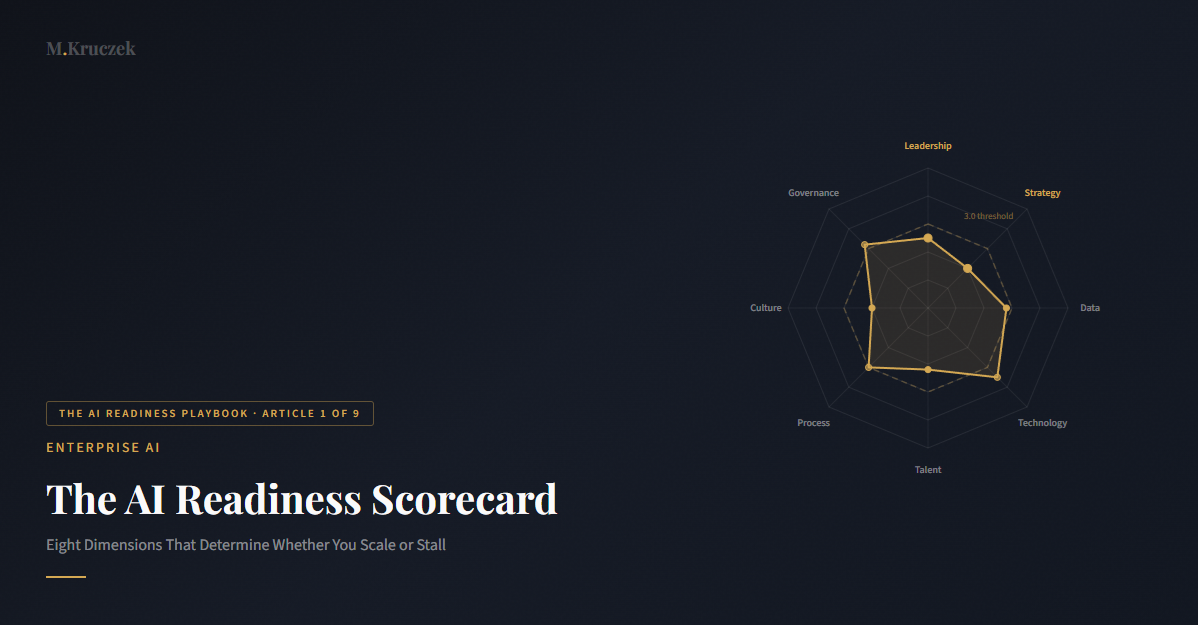
The scorecard in Article 1 tells you whether your Leadership Commitment dimension is above or below the 3.0 threshold. This article tells you why. The next article in the series turns to the second multiplier dimension: Strategic Alignment, and how to connect AI initiatives to business outcomes in ways that survive budget reviews.
Leadership and strategy together carry 3x the weight of any other single dimension. Get them both above threshold and everything else accelerates. Leave either one below 3.0 and nothing else matters.
References
- Stuart, T. "Who in the C-Suite Should Own AI?" Harvard Business Review, March 2026. hbr.org
- Pertama Partners. "AI Leadership Failure Analysis." 2026. 84% of failures leadership-driven; 56% lose sponsor within 6 months.
- Pereira, Graylin, Brynjolfsson. "Enterprise AI Playbook: Lessons from 51 Successful Deployments." Stanford Digital Economy Lab, April 2026. stanford.edu
- IBM. "CAIO Adoption Survey." 2025. 26% of organizations now have a CAIO, up from 11%.
- CSuiteOutlook. "The Chief AI Officer Evolution: 2026-2027." csuiteoutlook.com
- PwC. "What's Important to the CAIO in 2026." pwc.com
- Cisco. "AI Readiness Index 2025." 8,000 organizations surveyed globally. cisco.com
This is Article 2 of 9 in "The AI Readiness Playbook" series, a step-by-step methodology for making your organization AI-ready. Connect with me on LinkedIn or Substack to discuss AI executive sponsorship and organizational readiness for your enterprise.