You keep reading the phrase and nobody explains it. So here is the whole thing, taught plainly: what it is, how it works, what it solves, and whether you need one.
If you only have a minute:
- What it is: software you feed your notes, meetings, and documents into, so you can later ask it questions in plain language instead of hunting for the answer yourself.
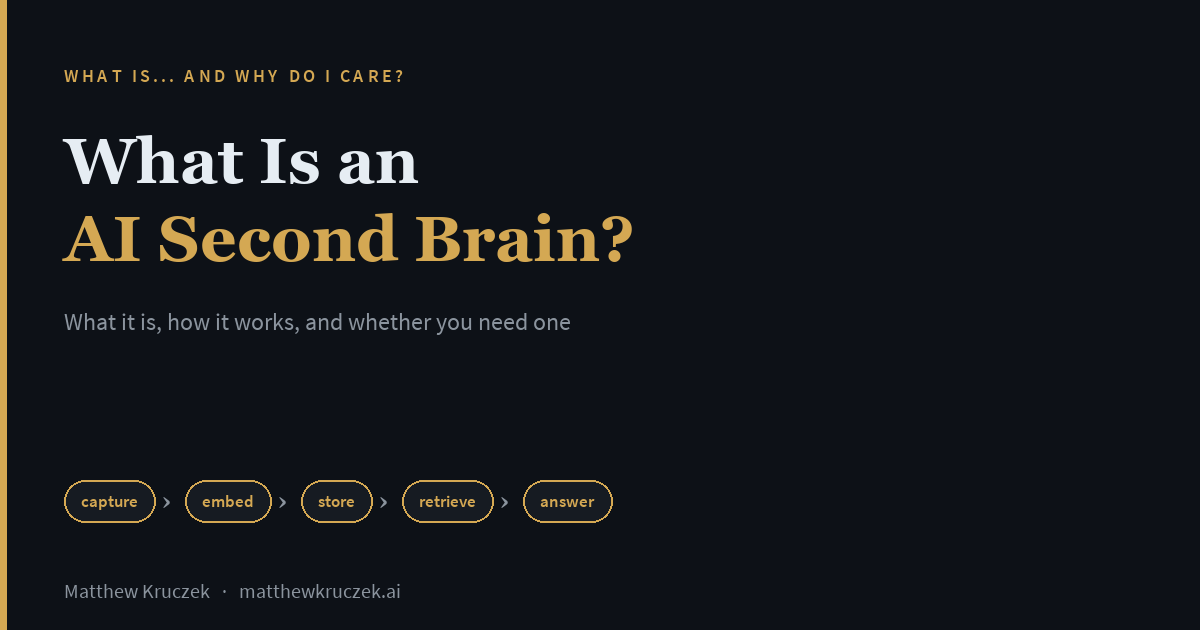
- How it works: five steps, capture, embed, store, retrieve, answer, the pattern the industry calls RAG. The catch: not one of those steps decides what was worth keeping. The machine has no judgment.
- What it solves: getting back what you already know but cannot hold in your head or find across scattered tools. Genuinely useful, as long as you remember that storing is not the same as understanding.
- Do you need one: two tests. Does what you hand over come back as a sharper you, or slowly replace your own thinking? (In one MIT study, 83% could not quote the essay AI helped them write.) And could you still use it if the vendor vanished tomorrow?
- Why you care: the same tool, scaled up, is the "enterprise memory" your company is already buying, and if you cannot walk away with what you put in, you do not own it. You rent it.
You have read the phrase in a dozen headlines this quarter. AI second brain. Give your team one. Give your whole company one. Never forget a meeting again. And in not one of those articles did anyone stop to explain what the thing actually is.
So let me teach it to you, in the four questions you would ask in order. What is it. How does it work. What problem does it solve. And the one that costs real money to get wrong: do you need one.
Here is the plainest answer I can give. An AI second brain is software you feed your notes, meetings, and documents into, so that later you can ask it questions in plain language and get an answer, instead of digging for it yourself. It remembers so you do not have to. Increasingly it does a little of your thinking too: summarizing a long thread, connecting two ideas you filed months apart, drafting from what it has read. Picture hiring an assistant whose entire job is to have read everything you have ever written and to answer questions about it on demand. That is the promise, in one image.
(This is the first in a series I am calling "What Is... And Why Do I Care?" I keep watching sharp people approve things they cannot define. Each installment takes one buzzword, explains it plainly, and tells you why it should change a decision. Second brain goes first because everyone is being sold one this quarter.)
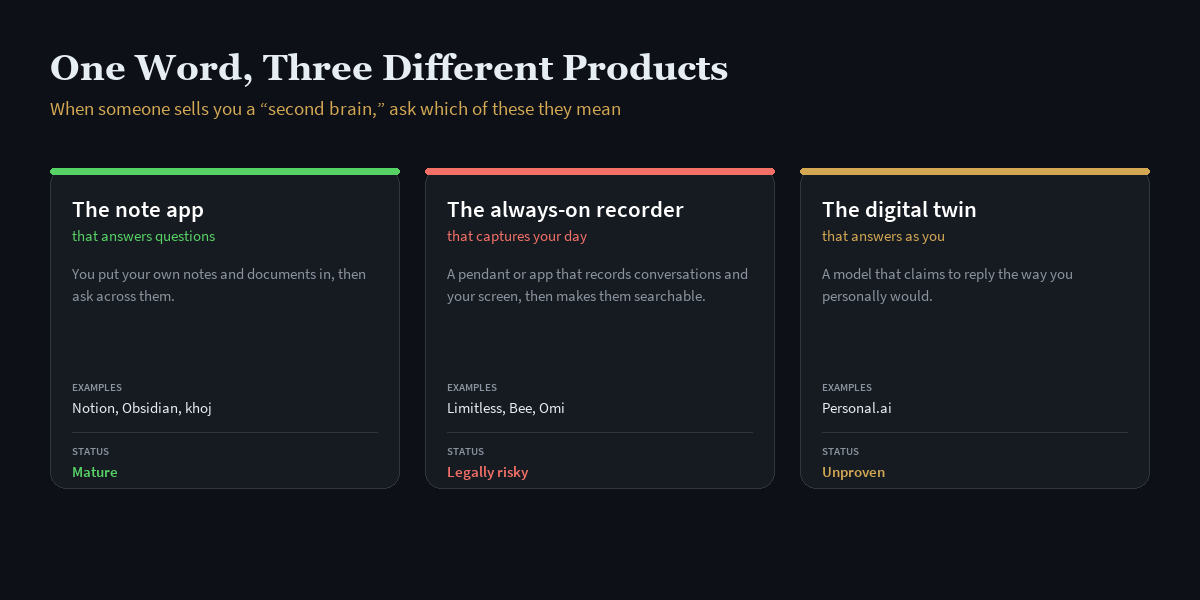
One thing to clear up before we open it up, because it trips people. "Second brain" is not one product but three, each wearing the same name. The first is a note app that answers questions, like Notion or Obsidian pointed at your own writing: you put things in, you ask, it answers. The second is an always-on recorder, a pendant or phone app that quietly captures your conversations and screen all day and makes them searchable. The third, and the shakiest, is a "digital twin," a model that claims to answer the way you personally would, which is mostly marketing at this point. They solve different problems and carry different risks, so when someone sells you a "second brain," your first move is to ask which of the three they mean.
How it works
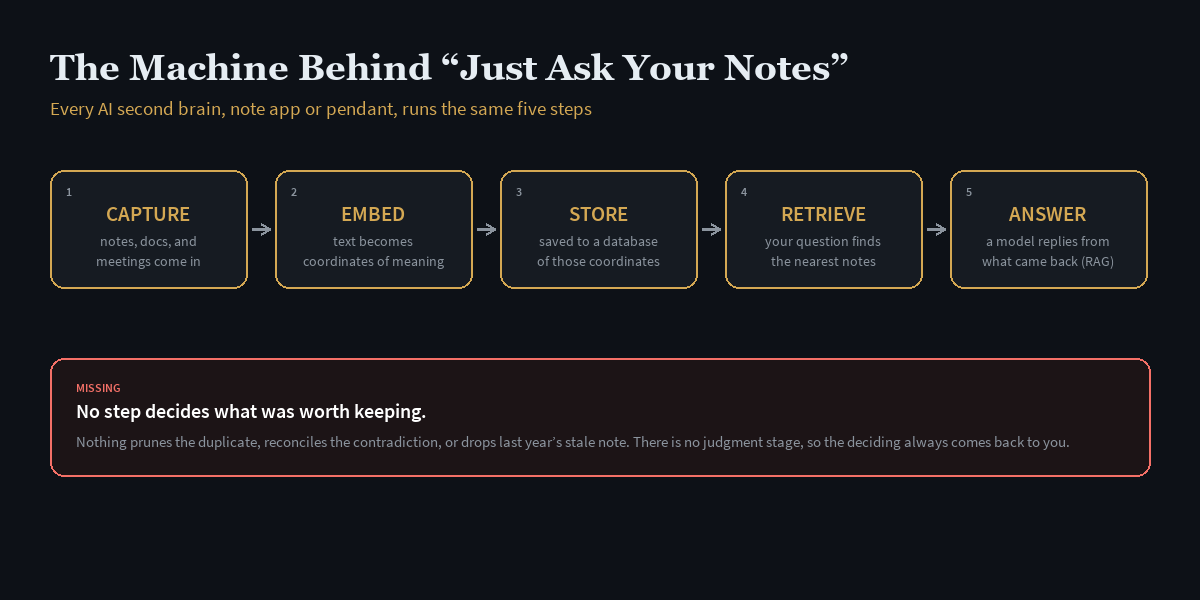
To really understand a second brain, you have to watch one work. So follow a single question through it: why did the Henderson deal stall? Under the hood, every one of these systems, note app or pendant, runs the same five steps.
Step one: capture. First it needs raw material. You type notes, upload documents, or let it record and transcribe your meetings. After a few months you have hundreds of these: call notes, emails, the transcript of the March meeting where the Henderson buyer went quiet the moment price came up. At this point it is just a pile of text. The system cannot make sense of it yet. It can only hold it.
Step two: embed. This is the step that makes the magic possible, so slow down here. Computers cannot search for meaning directly, they match exact words. So the system runs every note through an "embedding model," which reads a passage and turns it into a long list of numbers that stands for what the passage is about. Think of it as giving every note a set of map coordinates, so notes about similar things end up near each other, even when they use completely different words. "The buyer balked at the quote" lands right next to "pricing was a sticking point," because they mean the same thing. That map of meaning is what lets you "just ask" instead of guessing the exact keyword someone typed.
Step three: store. Those coordinates go into a database built to find nearest neighbors on that map fast. Good systems also keep a plain keyword index alongside it, because sometimes you do need an exact match, an error code, a contract number, a person's name, and the meaning-map is bad at those. A product that does only the meaning half and skips exact search is quietly weaker than it looks.
Step four: retrieve. Now you ask your question. Why did the Henderson deal stall? The system turns your question into coordinates the same way it did your notes, goes to that spot on the map, and grabs the handful of notes sitting nearest, including the March transcript, even though you never typed the word "stall" and neither did the transcript. That is the actual "search."
Step five: answer. Finally it hands those few notes, plus your question, to a language model, the same kind of AI behind ChatGPT, and asks it to write a plain answer using only what came back. Out comes: "The deal slowed after the March 12 call, when the buyer raised concerns about pricing." That pattern, pull the relevant pieces, then let the model answer from them, is common enough to have a name you will hear in every AI meeting: retrieval-augmented generation, or RAG. Now you know what those three letters actually mean.
That is the whole machine. And here is the lesson I want you to take from opening it up. Read the five steps again and look for the point where the system decides which notes were worth keeping, throws out the duplicate, or notices that a note from last year is no longer true.
It is not there.
The machine captures, stores, finds, and answers. Not one of its steps involves judgment: deciding what matters and what to throw away. That is not a missing feature you can fix by buying the better app. It is missing from the whole design. The system remembers everything you give it with equal loyalty, the sharp insight and the throwaway note and the same idea you wrote down four times, and it will never once tell you which was which. It remembers. You still have to be the one who decides. Hold onto that, because it explains everything that follows.
What problem it solves
Now that you have seen the machine, the real problem it addresses gets clear, and it is not the one the ads name.
The ads say: never forget anything. But forgetting was never really your problem. Your problem is that you know more than you can hold in your head, and it is scattered across places you cannot search. Notes in four different apps. A decision buried in a Slack thread from spring. The reasoning behind a call you made in March, which by now has shrunk in memory to just the conclusion, with the "why" gone.
For decades the answer to this was folders, and folders fail. It is worth understanding why, because it is exactly what the second brain fixes. Filing something in a folder assumes that the moment you save it, you already know how you will go looking for it later. You almost never do. That Henderson note might matter someday under "pricing objections," or "deals that stalled," or "what this particular buyer cares about," and you cannot file it under all three. So it goes in one folder, or none, and when you need it you cannot find it.
The second brain's real trick is that it removes that guess. Because it searches by meaning, you do not have to have predicted the question. You ask in whatever words come to mind that day, and it finds the note anyway. That is genuine, and it is the part worth paying for: it turns a pile you would never dig through into answers you can actually get.
But notice the sharp edge, the same one from a minute ago. The system is brilliant at finding and useless at judging. It will just as happily hand you your best thinking or your worst, the current fact or the year-old one. Recording every meeting does not mean it captured a single decision, unless a person, or something, decided what the decision even was. Storing is easy. Understanding is the hard part, and that part still lands on a human. Which is exactly why the same tool that dazzles in a demo can quietly rot into a folder you stop opening.
So do you need one?
For most people the honest answer is yes, but a small one, aimed at a real problem, not the everything-machine the ads are selling.
Start with whether you even have the problem it solves. If you sit in a lot of meetings, carry a heavy reading load, or keep asking "what did we decide back in March," then finding what you already know is a genuine cost in your week, and a note app with AI will earn its place in about a week. If you mostly want a tidier to-do list or a nicer place to keep links, skip it. You will just end up with a more expensive to-do list.
If you are in, buy it for retrieval, not for capture. The value is in getting the right thing back, not in hoarding everything, and the two work against each other: the more junk you pour in, the worse the answers get and the faster it fills with clutter. One person who handed their vault to an AI to manage opened it later to find 497 copies of the same handful of ideas. So feed it the things you will genuinely go looking for, and be strict about the rest. A small, well-tended second brain beats a bloated one every time.
Then weigh the one real cost, the one no demo mentions. Because the machine has no judgment, it can only hand back what you put in, which means the thinking still has to be yours. That sounds obvious until you see how easily it slides the other way.
83% of people who wrote an essay with ChatGPT could not quote a single sentence from it minutes later. The words never felt like theirs.
Source: MIT Media Lab, "Your Brain on ChatGPT," 2025
Remembering and connecting ideas are things your brain does, and they weaken when you stop doing them. So use the tool to find and to draft, and keep the deciding for yourself. A second brain that helps you think is worth every dollar. One that does the thinking for you is a cost you will not notice until you reach for a skill that has gone soft.
One practical question settles the rest: if this vendor disappeared tomorrow, could you still use what you put in? If your notes live in a format only one company can read, you do not own your second brain, you rent it. Ask how you export everything, and in what form. A vague answer is the answer.
One exception. If the version tempting you is the always-on recorder, the pendant that captures every conversation, stop and think harder, because in a dozen US states recording someone without telling them is a crime. You cannot own a recording you were not allowed to make.
These are real, and they have already split apart
If you would rather see the machine than take my word for it, it is all open source. Pull the five most-starred "second brain" projects on GitHub and you get the whole story, because no two of them are the same product.
- khoj (about 35,000 stars) calls itself, in its own repo, "your AI second brain." Point it at your notes, run it yourself, ask questions across everything. The personal version, exactly as described above.
- Reor (about 8,500 stars) is the privacy-first take: a note app that runs the AI on your own laptop and auto-links related notes as you write. Nothing leaves your machine.
- Onyx (about 31,000 stars) is the same idea aimed at a company instead of a person, search across your organization's documents and tools. This is the open-source shape of the "enterprise" version the vendors are selling.
- Mem0 (about 60,000 stars), the most-starred of the five, is not a second brain for you at all, but a memory layer for AI agents. The brain belongs to the software.
- Omi (about 13,000 stars) is the open-source wearable, a device that listens to your conversations, for anyone willing to assemble it.
Five projects, one phrase, and they are a note app, a private vault, a company search engine, a memory chip for AI agents, and a microphone around your neck. That spread is the tell: "second brain" is not one thing yet, it is a label five different products are fighting over. And notice what none of them adds, however many stars it has: that missing judgment step. However you build it, the deciding still comes back to a person.
The same machine, pointed at your whole company
Two of those projects, the company search engine and the agent memory, hint at where this is really going, so follow it there, because this is the version that lands on your desk as a decision, not a gadget.
Everything you just learned about your own notes is true, unchanged, about your company's memory. A company has your problem, only bigger and more expensive. What it knows lives in people's heads, in channels nobody indexes, in the reasoning behind a decision that never got written down. People leave and it walks out with them. Run layoffs and you can erase years of hard-won context in a quarter and not notice until you reach for it.
So the exact same five-step machine got pointed at the organization instead of the individual, and given a more serious name: the "enterprise AI context layer." You feed it the company's documents, meetings, and tickets, people ask it questions in plain language, it retrieves and answers. Same capture, embed, store, retrieve, answer. And this is where the money is going. Granola started as a meeting notetaker and, in early 2026, raised $125 million at a $1.5 billion valuation repositioning around exactly this. Glean sells the same shape and promises institutional knowledge that, in their words, "compounds over time."
$1.5 billion. Granola's valuation as it pivoted from "meeting notetaker" to "enterprise AI context layer."
Source: TechCrunch, March 2026
Because it is the same machine, it has the same blind spot, no judgment, so you test it with the same two questions. They only get sharper at this scale.
Does the offload come back as capability? Recording every meeting is not the same as capturing the decision inside it. A system that faithfully stores every call and still cannot tell you why a project was killed has stored everything and understood nothing. At company scale, that failure comes with a budget line and a compliance risk attached.
Can you run it without them? This is the question that should stop a signature. If years of your company's decisions live inside one vendor's system, in a format only that vendor can read, you do not own your institutional memory. You are renting it, and the vendors know exactly what that is worth. Their own investor decks describe the "moat" as how painful it becomes to leave. A memory you cannot take with you is not an asset you own. It is a hostage someone else holds.
So the real question in front of you is not whether to buy one of these. Someone on your team already has. It is who owns the memory, whether it is capturing real reasoning or just transcripts, and what happens to your company's actual expertise if you let the machine do all the remembering while no one keeps doing the thinking.
What to do this week
Find out what is already recording. Someone on your team is running an AI notetaker in meetings right now. Learn which tool, where the recordings go, and whether the people in the room agreed to be taped. That is a legal question before it is a strategy one.
Decide what thinking stays human. Write down, on purpose, which judgments a person always makes. "The AI drafts, a person decides" only holds if you say it out loud, because the default is to let the tool creep.
Reward finding, not saving. Your notes or the company's, the value is in getting the right thing back, not storing more. Praise the person who deletes the duplicate, not the one who hoards.
Ask the exit question before you sign. For any memory tool, ask how you get everything out, in what format, on the day you leave. A vague answer means the trap is already closing.
So, the four questions, answered. What is an AI second brain? Software you offload your remembering, and some of your thinking, to. How does it work? Five steps that remember and retrieve for you, with no step that decides what mattered. What problem does it solve? Getting back what you already know but cannot hold or find. And do you need one? Only if what you hand over comes back as a sharper you, and only if you can take it with you when the vendor is gone.
Matthew Kruczek is Managing Director at EY, leading Microsoft domain initiatives within Digital Engineering. Connect with Matthew on LinkedIn to discuss how your organization should think about AI memory, context, and the knowledge that walks out the door.
References
- MIT Media Lab. "Your Brain on ChatGPT: Accumulation of Cognitive Debt when Using an AI Assistant for Essay Writing." June 2025. arXiv:2506.08872. arxiv.org
- TechCrunch. "Granola raises $125M, hits $1.5B valuation as it expands from meeting notetaker to enterprise AI app." March 2026.
- Glean. "Enterprise Graph" and Work AI Institute product materials. December 2025.
- r/PKMS community discussions. "My AI-managed knowledge base quietly accumulated 497 duplicate files." 2026.
- Reporters Committee for Freedom of the Press. Two-party consent recording laws by state. Accessed 2026.
- GitHub repositories, star counts as of July 2026: khoj-ai/khoj, reorproject/reor, onyx-dot-app/onyx (formerly Danswer), mem0ai/mem0, BasedHardware/omi (formerly Friend).