If you only have a minute, here's what you need to know.
- Agentic AI doesn't just automate tasks. It makes decisions within processes. Measuring it with the same KPIs you used for RPA will give you numbers that move without telling you anything useful.
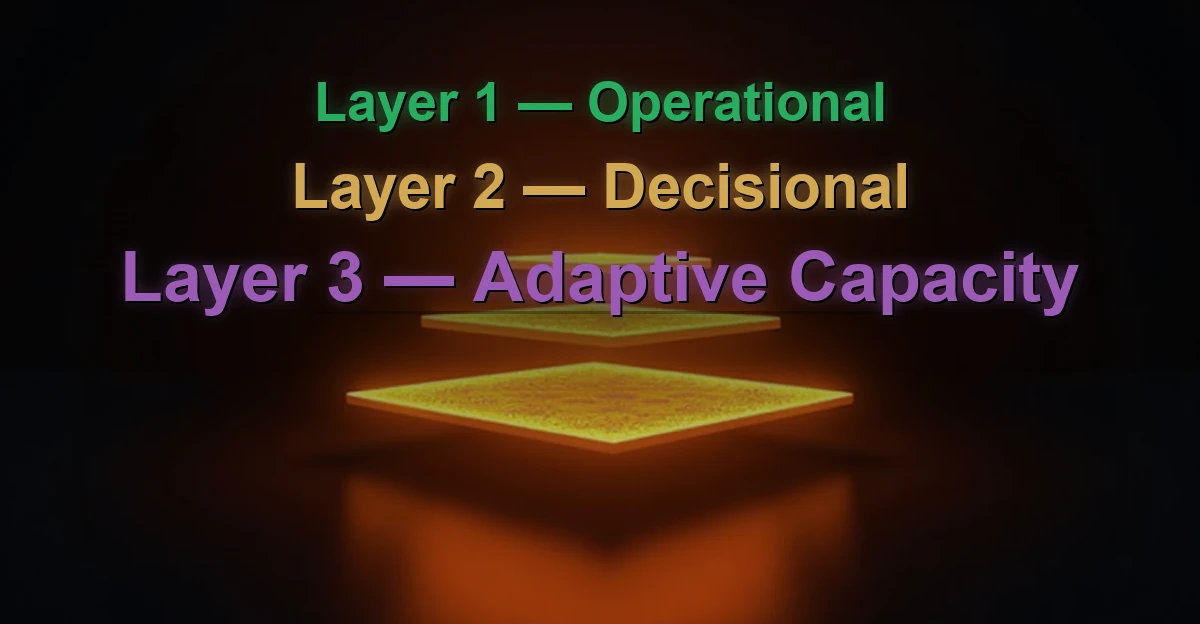
- Most enterprises are sitting at Layer 1: operational metrics like FTE saved and cycle time reduction. These matter, but they're the floor, not the ceiling.
- Layer 2 metrics measure decision quality: how often the agent made the right call, how often humans overrode it, and where confidence broke down. This is where most organizations have a measurement gap today.
- Layer 3 metrics measure adaptive capacity: whether the agent is expanding what the process can do, not just running the existing process faster. This is where transformational value lives.
- The biggest measurement mistake leaders make is declaring success when Layer 1 numbers improve, before checking whether Layers 2 and 3 are even being tracked.
Nearly every leader I talk to right now has some version of the same conversation. Their team has introduced an AI agent into a core process. Something is clearly happening. The numbers are moving. But when the business asks "what's the impact?", the answer sounds thinner than the experience feels.
That gap between what's happening and what the metrics are capturing is not an accident. It's structural.
Agentic AI is not automation. Traditional automation executes a predetermined sequence of steps. An agent evaluates context, makes judgment calls, handles exceptions, and adapts to conditions the original process designer never anticipated. When you put an agent into a business process, you are not installing a faster conveyor belt. You are introducing a new decision-maker.
Most enterprises are still measuring the conveyor belt.
The problem with your current dashboard
When organizations first deploy AI agents, the metrics that surface naturally are the ones already on their dashboards: cycle time, task volume, FTE hours, cost per transaction, error rate. These numbers are real and they matter. But they were designed to measure deterministic processes, where the only question is how fast and how reliably the sequence runs.
Agents introduce non-determinism. They don't always take the same path. They encounter novel situations and handle them in ways the process never specified. They can escalate appropriately, fail silently, or make calls that are locally correct but strategically wrong.
None of that is visible in your existing KPIs.
The organizations that are ahead on this have built a three-layer measurement framework. Each layer answers a different question.
Layer 1: Operational metrics (the efficiency floor)
These are the metrics every organization starts with, and they are necessary.
- Tasks completed per agent per hour
- Cycle time reduction versus the baseline measured before deployment
- Cost per transaction with and without agent involvement
- Volume handled without human escalation
- Error and exception rate
Layer 1 answers the question: is the agent doing the work? For any deployment to justify itself, these numbers need to be positive. Organizations seeing 60-80% reductions in cycle time are tracking Layer 1 metrics well.
The failure mode is stopping here. Layer 1 tells you the agent is running. It does not tell you the agent is running well.
Layer 2: Decisional metrics (the quality layer)
This is where most organizations have an active measurement gap, and where the most important diagnostic information lives.
Agents make decisions. Those decisions have quality. Quality can be measured.
Human override rate. When a human reviews an agent's output, how often do they change it? A high override rate on routine tasks signals miscalibration. A low override rate on genuinely complex tasks signals overconfidence, often more dangerous than the first problem.
Confidence threshold distribution. Well-designed agents signal uncertainty. Track how often your agent is operating at high, medium, and low confidence, and whether those self-assessments correlate with actual accuracy. An agent that reports high confidence but triggers frequent corrections needs retraining or rescoping.
Exception escalation precision. When the agent escalates to a human, is the escalation justified? Track both the rate and the appropriateness. Agents that over-escalate are expensive. Agents that under-escalate are dangerous.
Decision reversibility lag. How often is an agent decision reversed after the fact, and how much time passes before the reversal? Irreversible decisions made incorrectly compound before they surface. This metric is particularly important in financial, compliance, and customer-facing processes.
Novel situation handling rate. What percentage of tasks fall outside the agent's training distribution? This tells you something important about whether the deployment scope is well-matched to the agent's actual capabilities.
These metrics require intentional instrumentation. They will not appear in your process management tool by default. Building the logging and evaluation layer to capture them is non-trivial work, and it is exactly the work most organizations skip because Layer 1 numbers look acceptable.
Layer 3: Adaptive capacity metrics (the transformation ceiling)
This layer measures something qualitatively different from the other two. Not whether the agent is running, and not how well it's making decisions within the existing process. Instead: whether the process itself is expanding because the agent exists.
This is the measurement of transformational value. It is also the hardest to quantify, because it requires a counterfactual. You are measuring what is now possible that was not possible before.
New capability acquisition rate. How quickly can you extend the agent to handle adjacent task types? An agent that required six weeks of development to add a new task type in its first quarter, but only two weeks by its fourth quarter, is compounding capability. One that remains at six weeks is not.
Human attention quality shift. Are the humans who work alongside the agent spending more of their time on genuinely high-judgment work? Track what your people are actually doing now versus what they did before. If agent deployment simply freed them up for more of the same work, Layer 3 value is not materializing. If it redirected their attention toward decisions that actually require human judgment, it is.
Process boundary expansion. Has the agent enabled the organization to take on scope that would have been infeasible before? Agentic AI's most significant impact in mature deployments is not doing the same process faster. It is doing a different, more ambitious version of the process that was previously impractical at scale.
Time-to-value on new process introductions. As you add new processes to your agent environment, how long does the ramp from introduction to operational stability take? Organizations where this number is declining have built genuine organizational capability. Those where it stays flat are running deployments, not building systems.
What this looks like in practice
Consider a representative scenario: a global financial services firm deploys an agent to handle initial client inquiry triage. Six months in, Layer 1 metrics look excellent. Inquiry cycle time is down 65%. Volume handled without escalation is up significantly.
But Layer 2 reveals a problem the leadership team hadn't seen. The human override rate on medium-complexity inquiries is 34%, far above the 10-12% the team had assumed. And the override rate is higher on cases the agent rates as high confidence than on cases it flags as uncertain. The agent is most wrong when it thinks it's most right.
Without Layer 2 metrics, this organization would have declared the deployment a success. With them, they have a clear retraining target, a scope adjustment to consider, and a monitoring requirement to build.
Layer 3 metrics tell a different story. The same organization discovers that because agent triage is now handling volume that previously required four full-time analysts, those analysts are available to work on relationship-intensive activities the team never had capacity for before. A new capability has emerged. That value was always latent in the process. The agent made it accessible.
| Layer | Question Answered | Key Metrics | Gap Risk |
|---|---|---|---|
| Layer 1 Operational |
Is the agent doing the work? | Cycle time, FTE saved, volume, cost per task | Declaring success too early |
| Layer 2 Decisional |
Is the agent making the right calls? | Override rate, confidence calibration, escalation precision | Silent failures compounding |
| Layer 3 Adaptive |
Is the agent expanding what's possible? | Capability ramp time, attention quality shift, process expansion | Missing transformational value entirely |
What to do this week
Audit your current measurement approach. Which layer are you sitting in? If your entire agentic AI measurement program is Layer 1 metrics, you have a blind spot problem regardless of how good the numbers look.
Build the Layer 2 instrumentation. The human override rate, escalation precision, and confidence calibration metrics require logging at the agent decision level. If your current deployment does not produce this data, that is your first engineering priority.
Define your Layer 3 baseline. Before you can measure what new capabilities the agent creates, you need a documented picture of what the process could and could not do before deployment. This does not require sophisticated tooling. It requires a clear-eyed audit of process scope and capacity constraints.
Don't wait for the framework to be complete before sharing it. Your leadership team is asking this question now. A two-slide summary of the three-layer framework, paired with honest assessment of which layer you are currently measuring and which you are not, is more useful than a fully instrumented measurement system that arrives in six months.
The organizations that will be ahead on agentic AI measurement are not the ones with the most sophisticated dashboards. They are the ones that correctly understood what they were measuring in the first place.
References
- McKinsey & Company. "The state of AI in early 2024." March 2024. mckinsey.com
- IDC. "Worldwide Artificial Intelligence Spending Guide." 2025.
- Gartner. "How to Measure the Business Value of AI." 2025. gartner.com
- Sequoia Capital. "AI's $200 Billion Question." 2024. sequoiacap.com
- Kruczek, M. "How Do I Get Started with the Agent-First Enterprise?" matthewkruczek.ai. matthewkruczek.ai
- Kruczek, M. "The AI Adoption Paradox." matthewkruczek.ai. matthewkruczek.ai
- Markets and Markets. "AI Agents Market, Global Forecast to 2032." 2025.
This article is part of "The Agent-First Enterprise" series exploring how organizations can transform their operations around AI agent capabilities. Connect with me on LinkedIn or Substack to discuss agentic AI measurement frameworks and impact assessment for your organization.