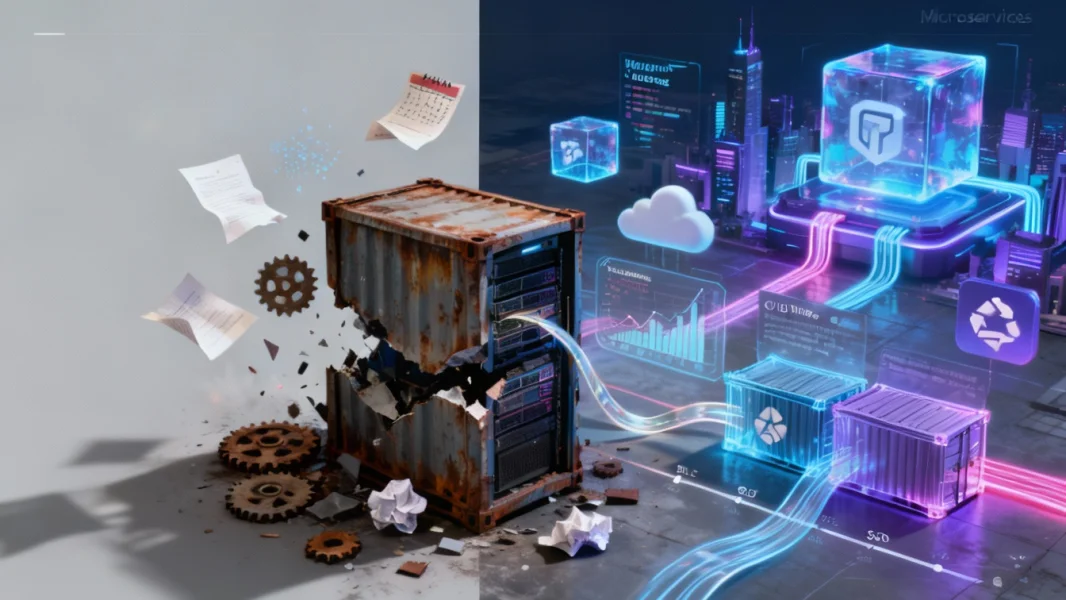
When the Way You Build Software Changes, Everything About Modernization Changes Too
Global digital transformation spending is forecast to reach $3.9 trillion by 2027, with the application modernization services market projected to surge from $21.06 billion in 2024 to $78.21 billion by 2033. Yet most organizations are approaching modernization with a fundamental blind spot: they're modernizing applications using the same human-centric SDLC processes that created the technical debt problem in the first place. The convergence of application modernization with agent-powered software development represents the most significant opportunity—and risk—facing CTOs today. Organizations that recognize modernization as an integrated strategy for transforming both applications and development processes will achieve 10x advantages over competitors still treating these as separate initiatives.
The Modernization Paradox: Solving Yesterday's Problems with Yesterday's Methods
Here's the uncomfortable truth that most application modernization strategies ignore: you're spending millions to update applications that were built using human-centric development processes, and you're planning to maintain and extend them using those same outdated processes.
Technical debt accounts for about 40% of IT balance sheets, with companies paying an additional 10-20% to address tech debt on top of the costs of any project. U.S. technical debt accumulation has reached $1.52 trillion, and nearly two-thirds of businesses invest more than $2 million annually on maintaining and upgrading legacy systems.
But here's what the statistics don't capture: that technical debt was created by human-centric development workflows—sequential processes, manual coding, limited testing, slow iteration cycles. And most modernization strategies assume you'll continue using those same workflows to maintain and extend the modernized applications.
It's like renovating a house while using the same faulty construction methods that caused the original problems. You'll just create new technical debt faster because the modernized applications will be more complex.
Why Traditional Modernization Falls Short in an Agent-Powered World
According to IDC research and forecasts, 90% of applications will be cloud-native by the end of 2025. Organizations are investing heavily in re-platforming, containerization, microservices architectures, and cloud migration.
These are necessary steps. But they're not sufficient.
The Missing Piece: Development Process Transformation
Moving to cloud-native architectures doesn't address how you'll build, maintain, and extend those applications. 78% of organizations expect AI to facilitate application modernization, yet most are thinking about AI as an accelerator for existing processes, not as a fundamental reimagining of how software gets built.
The convergence insight: application modernization and SDLC transformation aren't separate initiatives. They're two sides of the same strategic challenge.
Consider what happens when these strategies remain disconnected:
Scenario 1: You modernize the application but not the process
- You re-architect a monolith into microservices
- You move from on-premise to cloud-native
- You achieve better scalability and resilience
- But maintenance and feature development still follow human-centric workflows
- Result: You've reduced some technical debt but you'll create new debt at the same rate as before
Scenario 2: You transform the SDLC but not the applications
- You adopt agent-powered development processes
- Your teams learn specification writing and orchestration
- New development becomes exponentially faster
- But legacy applications remain brittle, difficult to modify, and poorly documented
- Result: Your new capabilities are constrained by applications designed for old processes
Scenario 3: You integrate both transformations (The Strategic Approach)
- Modernization decisions are informed by agent-powered development capabilities
- Applications are re-architected not just for cloud but for agent-native maintenance
- The modernization process itself uses agent orchestration
- Legacy technical debt becomes fuel for training agents and building specifications
- Result: Compounding advantages that competitors can't match
The Convergence Framework: Modernization Meets Agent-Powered Development
The strategic opportunity lies in recognizing that modernization isn't just about the application—it's about the entire development lifecycle that will maintain and extend that application for the next decade.
Rethinking the Modernization Decision Matrix
Traditional modernization frameworks evaluate applications across dimensions like:
- Technical obsolescence
- Maintenance costs
- Business criticality
- Integration complexity
- Compliance requirements
The agent-powered modernization framework adds critical new dimensions:
Specification Clarity: Can this application's business logic be clearly specified? Applications with well-defined rules and outcomes are ideal candidates for agent-powered maintenance. Complex applications with ambiguous requirements need human-centric modernization first.
Modularity Potential: Can this application be decomposed into services that agents can independently maintain? Monolithic applications designed for human developers need re-architecture before agent-powered SDLC delivers value.
Test Coverage Feasibility: Can we create comprehensive automated testing for this application? Agent-powered development requires robust testing infrastructure. Applications lacking testability need modernization that prioritizes test creation.
Documentation State: Is there sufficient understanding of what the application does and why? Agent orchestration works best with clear specifications. Applications with poor documentation need archaeological work before modernization.
Integration Architecture: Does this application expose well-defined APIs? Agent-powered maintenance requires programmatic interfaces. Applications with hardcoded integrations need API-first re-architecture.
The Four Modernization Archetypes in an Agent-Powered World
Archetype 1: Retire and Rebuild with Agent-First Principles
Characteristics:
- Core business logic is well understood
- Current application has severe technical debt
- Business requirements are relatively stable
- Clear success criteria exist
Strategic Approach: Use agent-powered development to rebuild from scratch. The economics have fundamentally changed: what would have taken 18 months with traditional development might take 3-4 months with agent orchestration. The rebuilt application is designed from day one for agent-native maintenance.
Business Case: Organizations that proactively reduce technical debt realize a 20-30% faster time to market on new digital initiatives. When you can rebuild in months rather than years, "retire and rebuild" becomes strategically viable for applications that would never have qualified before.
Example: A financial services company had a loan processing system with 20+ years of technical debt. Traditional modernization would cost $4M and take 18 months. Using agent-powered development, they rebuilt the entire system in 4 months for $1.2M, with specification-driven architecture that enables continuous evolution.
Archetype 2: Gradual Refactoring with Agent Assistance
Characteristics:
- Application has business value but significant technical debt
- Risk tolerance is low (can't afford disruption)
- Business logic is partially documented
- Integration points are well-defined
Strategic Approach: Use agent-powered development to incrementally extract functionality into new services while maintaining the legacy core. Agents handle the tedious work of code analysis, test generation, and service extraction. Human architects guide the refactoring strategy.
Business Case: Breaking down the modernization into manageable chunks can free up engineers to spend as much as 50% more of their time working on value-generating products and services. Agent assistance accelerates each extraction cycle while maintaining quality.
Example: A retail company's inventory management system was too critical to replace completely. Using agent-powered refactoring, they extracted one capability per sprint—catalog management, pricing, fulfillment—into new microservices. Each extraction took 2-3 weeks instead of 2-3 months. After 12 months, 70% of functionality was in agent-maintainable services.
Archetype 3: Specification-First Modernization
Characteristics:
- Application domain is complex
- Business logic is embedded in code without documentation
- Multiple teams maintain different parts
- Compliance requirements are stringent
Strategic Approach: Before modernizing code, modernize understanding. Use agent-assisted code analysis to extract business logic and create comprehensive specifications. These specifications become the foundation for both modernization and ongoing maintenance.
Business Case: Most modernization projects fail because teams don't understand what the legacy application actually does. Legacy systems often have significant accumulation of technical debt due to their age, with original design decisions becoming outdated and documentation that may be incomplete, outdated or lost over time. Specification extraction creates organizational knowledge assets that outlive any particular implementation.
Example: A healthcare provider had a claims processing system that nobody fully understood. Rather than attempting direct modernization, they used AI agents to analyze code, extract business rules, and generate specifications. This 3-month discovery phase revealed that 40% of the code implemented rules that were no longer relevant. The modernization that followed was faster, cheaper, and more accurate because they understood what actually needed to be preserved.
Archetype 4: API-Wrapper Strategy with Progressive Enhancement
Characteristics:
- Legacy system is stable and reliable
- Technology is obsolete but functionality is sound
- Complete replacement isn't economically justified
- Integration is the primary challenge
Strategic Approach: Rather than modernizing the core application, create a modern API layer using agent-powered development. The legacy system becomes a black box accessed through well-defined interfaces. New capabilities are built as agent-native services that integrate through the API layer.
Business Case: API-first apps enable companies to integrate third-party tools, services, and technologies quickly, contrasting traditional systems where adding new features demands significant code rewrites. This approach delivers immediate value while deferring expensive core modernization.
Example: A logistics company had a 30-year-old routing system that worked perfectly but couldn't integrate with modern platforms. Rather than replacing it, they built an API wrapper in 6 weeks using agent-powered development. New mobile apps, customer portals, and AI-powered analytics all connect through the modern API while the legacy core continues running unchanged.
The Modernization-SDLC Convergence in Practice
Phase 1: Strategic Assessment
Evaluate Both Dimensions Simultaneously
Don't start with "which applications should we modernize?" Start with "which applications can benefit from both modernization AND agent-powered development?"
Critical Activities:
Application Portfolio Analysis Through an Agent Lens:
- Which applications have clear, specifiable business logic?
- Which have comprehensive test coverage or could easily gain it?
- Which are modular or could be decomposed?
- Which have APIs or could be wrapped with APIs?
SDLC Readiness Assessment:
- Where is your organization in adopting agent-powered development? (Crawl/Walk/Run)
- What specification and orchestration capabilities exist?
- Which teams are ready for agent-native development?
- What infrastructure exists for agent orchestration?
Convergence Opportunity Mapping: Score each application across two dimensions: modernization urgency and agent-development readiness. The high-high quadrant represents your strategic starting point.
Phase 2: Pilot Convergence Projects
Select Applications That Demonstrate the Convergence Value
Choose 2-3 applications that benefit from both modernization and agent-powered development. These pilots prove the integrated approach delivers advantages that neither strategy alone could achieve.
Success Metrics:
- 50-70% reduction in modernization cycle time
- Equal or better quality compared to traditional approaches
- Clear documentation and specifications for ongoing maintenance
- Demonstrated agent-native maintenance capabilities
Phase 3: Integrated Modernization Strategy
Scale the Convergence Approach Across Your Portfolio
Strategic Framework:
Tier 1: Agent-Native Rebuilds — Applications where agent-powered development enables complete replacement that wouldn't otherwise be economically viable. These are your highest-value targets because the ROI compounds: faster initial modernization + ongoing agent-native maintenance + continuous evolution capability.
Tier 2: Agent-Assisted Refactoring — Applications where agents accelerate decomposition, testing, and service extraction. The hybrid approach reduces risk while building agent-powered capabilities.
Tier 3: API-Wrapped Preservation — Applications where agent-powered API development enables modern integration without touching the legacy core. Quick wins that enable business value while deferring expensive core modernization.
Tier 4: Specification-First Understanding — Complex applications where agent-assisted code analysis must precede any modernization decision. The specifications themselves become valuable assets that inform future architecture.
Resource Allocation:
- 40% of effort on Tier 1 (highest strategic value)
- 30% on Tier 2 (balanced value and risk)
- 20% on Tier 3 (quick wins and integration)
- 10% on Tier 4 (knowledge creation)
Phase 4: Continuous Modernization Operating Model
Embed the Convergence Mindset into How You Work
The goal isn't completing a modernization program—it's creating an operating model where modernization and development process evolution happen continuously.
Operating Model Components:
Agent-Powered Modernization Teams: Cross-functional teams that combine domain expertise, specification architecture, agent orchestration, and traditional software engineering. These teams own both modernization execution and SDLC evolution.
Specification Repository: A living library of specifications extracted from legacy applications and created for modernized systems. This becomes organizational intellectual property that outlives any particular technology choice.
Progressive Autonomy Framework: Clear criteria for when agents can handle modernization tasks autonomously versus when human oversight is required. As capabilities improve, the autonomy boundary expands.
Continuous Value Assessment: Regular evaluation of which applications should be modernized, which should be maintained in place, and which should be retired. 47% of IT leaders cite technical debt as a major contributor to overspending on cloud and digital infrastructure. Continuous assessment prevents good money from following bad.
The Microsoft Azure Advantage in Modernization Convergence
Microsoft's integrated approach to both application modernization and AI-powered development creates unique advantages for organizations pursuing this convergence strategy:
Azure Migrate and Azure AI Integration: Azure Migrate provides comprehensive assessment and migration tools for legacy applications, while Azure AI Foundry offers enterprise-grade infrastructure for agent orchestration. The integration enables modernization workflows that incorporate agent capabilities from day one.
GitHub Copilot and Azure DevOps: GitHub Copilot accelerates code generation and refactoring, while Azure DevOps provides the orchestration infrastructure for agent-powered CI/CD. Organizations can modernize applications using the same tools that enable ongoing agent-native maintenance.
Azure OpenAI Service: Access to advanced language models through Azure OpenAI Service with enterprise security and compliance. These models power the code analysis, specification extraction, and refactoring agents that accelerate modernization.
Microsoft Fabric and Azure Synapse: Legacy applications often sit on top of complex data architectures. Microsoft Fabric and Azure Synapse enable modernizing both the application and the data platform simultaneously, with AI-powered data engineering that matches agent-powered application development.
The strategic advantage isn't just technical—it's that Microsoft's platform is designed for this convergence use case. Organizations aren't stitching together disparate tools; they're using an integrated platform where modernization and agent-powered development work seamlessly together.
The Skills Transformation: Modernization Engineers in the Agent Era
The convergence of modernization and agent-powered development creates demand for new skills that most organizations don't have:
Legacy Code Archaeologists with AI Tools: Professionals who can use AI agents to analyze legacy systems, extract business logic, and generate specifications. This requires understanding both old technologies and new AI capabilities.
Specification Architects: Experts who can translate extracted business logic into clear specifications that guide both modernization decisions and ongoing agent-powered maintenance.
Modernization Orchestrators: Leaders who can design integrated strategies that optimize across both modernization objectives and SDLC transformation, seeing the opportunities that exist only at the intersection.
Agent-Powered Refactoring Engineers: Technical specialists who can guide agents through complex refactoring tasks, ensuring that modernized applications are not just technically updated but designed for agent-native maintenance.
Organizations pursuing convergence strategies should invest in developing these capabilities now. The competitive advantage will belong to companies that master this intersection, not those that treat modernization and SDLC transformation as separate initiatives.
Getting Started: Your First Convergence Project
This Month:
- Identify Convergence Candidates: Review your modernization pipeline through an agent-development lens. Which applications benefit from both?
- Assess Agent Readiness: Where is your organization in agent-powered development maturity? What capabilities need development?
- Build the Business Case: Calculate the value of integrated transformation versus sequential approaches. The difference is often 3-5x.
- Secure Sponsorship: This convergence strategy requires executive support that spans both modernization budgets and SDLC transformation initiatives.
This Quarter:
- Launch Pilot Project: Select one application that demonstrates convergence value. Use agent-powered development to accelerate modernization while building agent-native maintenance capabilities.
- Develop Capabilities: Train teams in both modernization techniques and agent orchestration. These skills need to coexist in the same people.
- Build Infrastructure: Set up the tooling for both modernization (assessment, migration) and agent-powered development (orchestration, observability).
- Measure Everything: Track both modernization metrics (cost, time, quality) and agent-development metrics (specification clarity, autonomy levels, iteration velocity).
This Year:
- Scale Proven Patterns: Take learnings from pilots and apply across modernization portfolio using the four-archetype framework.
- Embed Convergence Mindset: Make integrated assessment of modernization and agent-readiness standard practice for all application decisions.
- Build Centers of Excellence: Create teams that combine modernization expertise with agent orchestration capabilities.
- Establish Continuous Operating Model: Move from "modernization project" to "continuous evolution" mindset where applications are continuously refined using agent-powered approaches.
The Bottom Line: Modernization and SDLC Transformation Are One Strategy
The application modernization services market is projected to grow from $21.06 billion in 2024 to $78.21 billion by 2033. Billions of dollars will be spent modernizing applications over the next decade.
The question is whether those billions will be spent using old methods to create systems that will accumulate new technical debt, or using agent-powered approaches that deliver compounding advantages.
85% of organizations reported that time spent maintaining legacy systems hampers their ability to launch new solutions, with 79% indicating that technical debt forces them to divert resources away from core objectives.
The solution isn't just modernizing those applications. It's modernizing both the applications AND the development processes that will maintain them for the next decade.
Organizations that recognize modernization and agent-powered SDLC transformation as one integrated strategy will:
- Complete modernization 2-3x faster than traditional approaches
- Build systems designed for continuous evolution, not periodic overhaul
- Develop organizational capabilities that compound over time
- Create competitive advantages that are difficult for others to replicate
Those that treat these as separate initiatives will spend more, take longer, and deliver results that are obsolete before they're complete.
The convergence opportunity is here. The technology is ready. The business case is proven. The only question is whether you'll lead this transformation or be disrupted by it.
This article is part of "The Agent-First Enterprise" series exploring how organizations can transform their operations around AI agent capabilities. Connect with me on LinkedIn to discuss application modernization and agent-powered development strategies.